Wednesday, April 9, 2025

This is still the Everything Risk moment

This isn't the newsletter piece I had intended or even wanted to write. But given the massive tariff levies, the 90-day pause for non-retali
View in browser
Bloomberg

This isn't the newsletter piece I had intended or even wanted to write. But given the massive tariff levies, the 90-day pause for non-retaliation and wild market gyrations we are now seeing, events over the last 24 hours have overtaken my plans. As it stands, the S&P 500 just about tipped into a bear market before news that there was a 90-day reprieve caused a huge relief rally. I think there's still a high likelihood that tariffs against China creates a recession and another collapse in stocks. This is truly the Everything Risk moment for the US: The entirety of the US-based asset system, from stocks to US Treasuries and the dollar, are still at risk of a collapse in value.

Here's a brief synopsis of why:

  1. Pretty much every market economist has moved to talking about a recession as a base case now. Most had expected tariffs and a slowdown. But they didn't expect rates to be this high. And they also didn't expect an all-out trade war between China and the US.
  2. Even though recession is a base case, it's not necessarily what the near-bear market is telling us. A lot of that fall has to do with unrealistically high expectations being dashed. P/E ratios are still high.
  3. If we look at this in the context of an already deflating super bubble, we still have time to avoid the analogous stagflation period of back-to-back recessions in 1970 and 1974. I still hold some hope for that.
  4. But Trump is doing exactly what you need to crash the market by potentially unanchoring inflation expectations.
  5. What's more, his aggressive moves are creating widespread distrust in the US as a safe haven with a predictable rule of law. That distrust could cause a depreciation in US dollar asset values.
  6. What the Fed does next is where a lot of this will be decided.

The bad outcome probabilities have skyrocketed

Let's start with the obvious. Recent events have made clear that a recession and extended bear market in stocks are now the base case. Just three weeks ago, I outlined four risk scenarios — from best-case to medium to high-risk and finally worst-case —  handicapping the medium-risk scenario as slightly more likely than the high-risk one. And where my low-probability tag for a best-case outcome was probably non-consensus then, it seems to be more of the status quo now.

If I had to re-assess risk weightings today, I would give the "Goldilocks" outcome that keeps stock charts going up and to the right a zero weight simply because we are basically in a bear market already. Of the more negative outcomes, even the non-recession case has to be seen as lower probability. Already, companies like Delta Air and Walmart are pulling their earnings guidance. More companies will follow as firms absorb crushing tariff costs with a combination of margin loss and cost cutting that includes layoffs. So we can reasonably put recession as a base case with the question now about its severity. My current odds: 25% growth recession, 50% recession/bear market and 25% severe bear market — with a not insignificant potential for this to turn into something worse, including a financial crisis.

The starting point matters

Let's remember where we're coming from because, as the saying goes, the bigger they are, the harder they fall. The more priced to perfection markets are, the more vulnerable they are to negative shocks. And upside expectations coming into this year were dangerously high.

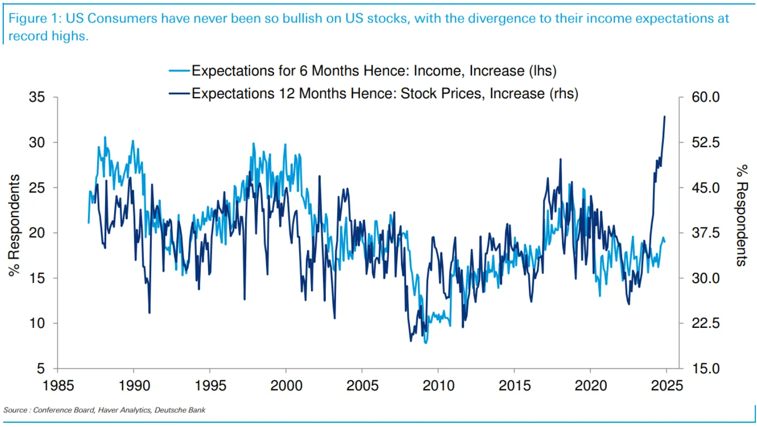
For example, last year ended with me writing about off-the-wall unrealistic expectations. Remember this chart from Deutsche Bank? The optimism was even greater than in 2000, at the height of the Internet Bubble.

So when it was clear tariffs were coming, that they weren't just a negotiating tool, it quickly led to a correction in stocks. I would argue that because of the starting point — the irrational exuberance and the high valuations — the bear market in stocks is just an indication that investors have marked down medium-term expectations. It's a stumble from a high plateau, making the downdraft large. But the bear market hasn't fundamentally altered many investors' belief in American exceptionalism as embodied by Big Tech and Silicon Valley. If that belief falters, there will be a lot further to fall from here.

The Super Bubble had already been deflating

Let's put this in context, though. As 2024 closed out, we had unrealistic expectations for future stock market gains. And they were met by an economic shock in the form of tariffs that eventually were revealed as unexpectedly high. That precipitated a bear market in stocks. And now we wait for tariff retaliation and how much the global economy suffers to determine if stocks have been marked down enough so far.

But, remember, by my reckoning, the latest super bubble actually ended several years ago. And we are currently just moving further downward from a double peak in 2019 and 2021, four to six years ago. Where we had over 200% decade-long equity gains in excess of inflation back then, that number had been cut in half when I presented the super-bubble data last month. After the bear market, we are down to 75% inflation-adjusted gains over the last 10 years. That's not bad, but it could get a lot worse.

For example, I've said 2025 is the equivalent of around 1968 in the 1959-to-1982 equity super cycle. And the inflation-adjusted 10-year returns for the S&P 500 in mid-1968 were around the same as today. But in the middle of a recession in 1970 those gains turned to losses. In the middle of the next recession just four years later, you would have lost half your money in real terms had you invested in the S&P 500 basket of shares. And that's over a decade, so not just a blip but a severe shellacking that would have diminished your retirement standard of living.

In both the 25% weighted medium-risk scenario and the 50% weighted high-risk scenario, we can avoid such an outcome this time around.

Trump is doing exactly what you need to create a crash

I gave two outcomes that could create a crash when I introduced the super-bubble concept last month. One is a severe curtailment of US deficits. DOGE cuts aren't that big in terms of the US economy. And so, though it may hurt the economy in the Washington region where I live, it's not going to be a driver of a major downturn. You'd need major cuts to Medicaid, Medicare, defense and Social Security to get that outcome. I don't see that happening. Just the opposite is likely, a yawning deficit, maybe 8%, 9% or 10% of GDP if all of the tax cuts that Trump wants are enacted.

The other outcome that could lead to a crash is major stagflation. As I put it:

"If Trump's tariffs are more than a one-time price step-up, something that inflicts lasting damage on inflation rates due to unanchored inflation expectations, we could go from 3% CPI to 5%, just like in the late 1960s. And the exact same scenario would play out, with the Fed being forced to hike rates and the economy falling into a recession, spurring deep losses for stocks."

This is the real threat contained in the 25% weight I give to a severe downturn and major bear market because Trump's tariffs make that outcome possible.

De-dollarization

But there's another threat brewing that could exacerbate the downturn in stocks and cause a financial crisis, and that's the emerging loss of faith in US assets. We can see that developing via the recent spike in Swiss francs, euros and Japanese yen versus the dollar.

George Saravelos, the Head of FX Strategy at Deutsche Bank, has been warning of this for a month ever since the Trump tariff regime got going. He made three points recently.

  1. The market "has lost faith in US assets, so that instead of closing the asset-liability mismatch by hoarding dollar liquidity, it is actively selling down the US assets themselves." This could lead to a precipitous drop in the US dollar, causing more flight out of dollar assets in a vicious cycle down.
  2. The Trump administration's policies are encouraging a selloff in US Treasuries, by raising inflation and inflation expectations and making it nigh on possible for the Fed to cut rates. Saravelos also mentions the currency drop as undermining US Treasuries.
  3. A trade war could shift to a financial war. Basically, Trump has run out of tariff-related runway, with tariffs on Chinese goods now set at 104%. And the same is true for the Chinese with there equally draconian tariff on US goods. If there is any leverage to be had it will come via financial warfare given how many US assets the Chinese own.

And in this general de-dollarization, Treasury selloff and trade war with China, things could unravel quite quickly. There is a lot of money tied up in low-liquidity private market assets for example. What happens if the knock-on effects of de-dollarization means someone needs to sell those assets? We don't know. There are lot of unknown unknowns here in a world where assets are still overvalued both in public and private markets.

The Fed is the next fight

For me, this all points toward the Fed as the next battleground. Actually, that's the post I had wanted to write today — about how stagflation puts the Fed in a no-win position which invites a conflict with Trump. It's clear from his social media missives that Trump wants Fed rate cuts to help ease the pain of tariffs. I reckon that when policymakers do the sensible thing and resist cutting unless the labor market is dire, we may well see Trump attempt to take away the Fed's independence by hook or by crook.

Thus, a severe test lies ahead for the Fed. If they don't pass the test or Trump attempts to abrogate their independence, the result will be stagflation, unanchored inflation expectations and an acceleration of the de-dollarization themes Saravelos lays out and the potential for a financial crisis.  That's what this post was supposed to be about.

But now at least I've laid out the starting point. I see a 75% likelihood of recession with the Fed coming under extreme pressure to cut rates even as inflation hits 4% or 5%. Somewhere in there is an off-ramp where everyone saves face. If we don't find it, then the likelihood of a more severe downturn (and deep bear market) goes even higher than today's 25%, with negative consequences for long-term equity returns.

Quote of the week

"If recent disruption in the US Treasury market continues, we see no other option for the Fed but to step in with emergency purchases of US Treasuries to stabilize the bond market ("emergency QE"). This would be very similar to the Bank of England intervention following the gilt crisis of 2022."
George Saravelos
Global Head, FX Strategy, Deutsche Bank

Things on my radar

  •  Ray Dalio, the Founder of money manager Bridgewater Associates, rightly points to the collapse in the geopolitical order as a huge risk.
  • To give you a sense of the risks here, note that these are the highest tariffs in 100 years. And more are coming on things like pharmaceuticals. It's a crazy level of change. Trump was even considering higher tariffs.

More from Bloomberg

Like getting The Everything Risk? Check out these newsletters:

  • Markets Daily for what's moving in stocks, bonds, FX and commodities
  • Odd Lots for Joe Weisenthal and Tracy Alloway's newsletter on the newest market crazes
  • Economics Daily for what the changing landscape means for policymakers, investors and you
  • CFO Briefing for what finance leaders need to know

You have exclusive access to other subscriber-only newsletters. Explore all newsletters here to get most out of your Bloomberg subscription.

Bloomberg Markets Wrap: The latest on what's moving global markets. Tap to read.

Like getting this newsletter? There's more where that came from. Browse all our weekly and daily emails to get even more insights from your Bloomberg.com subscription.

Before it's here, it's on the Bloomberg Terminal. Find out more about how the Terminal delivers information and analysis that financial professionals can't find anywhere else.  Learn more.

Want to sponsor this newsletter? Get in touch here.

You received this message because you are subscribed to Bloomberg's The Everything Risk newsletter. If a friend forwarded you this message, sign up here to get it in your inbox.
Unsubscribe
Bloomberg.com
Contact Us
Bloomberg L.P.
731 Lexington Avenue,
New York, NY 10022
Ads Powered By Liveintent Ad Choices

No comments:

Post a Comment

đŸ‘€ BTC plunge: here's what to look out for

Navigate the latest $650M in liquidat...