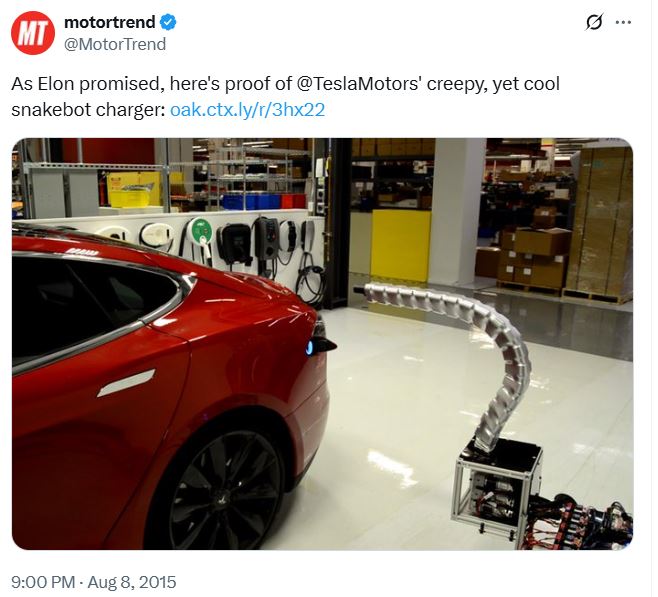
| Thanks for reading Hyperdrive, Bloomberg's newsletter on the future of the auto world. Programming note: Hyperdrive will be off for Good Friday and return Monday, April 21. Ten years ago, Elon Musk revealed Tesla was working on a charger that floated through the air and plugged itself into an electric car — in his words, like a solid-metal snake. Months after the CEO tweeted this, the company released a video of a prototype connecting with a Model S. The science fiction-like innovation generated buzz at a time when Tesla was tiny and Musk was a media darling. "That really looks like the thing that jacks into the back of Neo's head in The Matrix," Stephen Colbert enthused on The Late Show. Musk cracked a joke about how one shouldn't drop anything when standing near the prototype. A decade later, Tesla has yet to commercialize the snake-bot charger, and Musk has become the butt of Colbert's jokes. "There's a silver lining on the implosion of the world economy — it's bad for Elon Musk, too," he said last month, to rapturous applause. But while Tesla's autonomous chargers are still nowhere to be found, a Dutch startup has built such a device that's actually starting to be put to use. Rocsys, a company co-founded and led by an entrepreneur who's already started and sold one EV charging startup to Swedish-Swiss multinational ABB, demonstrated its debut offering — the ROC-1 — at the Port of Rotterdam this month. An electric DAF Trucks model drove autonomously around the port to a charging area where the ROC-1 was waiting. The device's robotic arm reached out to connect with the truck's charging inlet. Once the battery was topped up, the automated truck navigated its way to a pickup point elsewhere on the port grounds. "All the infrastructure is built for humans, but when cars have no driver anymore there is a gap," Rocsys CEO Crijn Bouman says. "We want to offer the platform to basically convert the infrastructure to be suitable for self-driving vehicles." 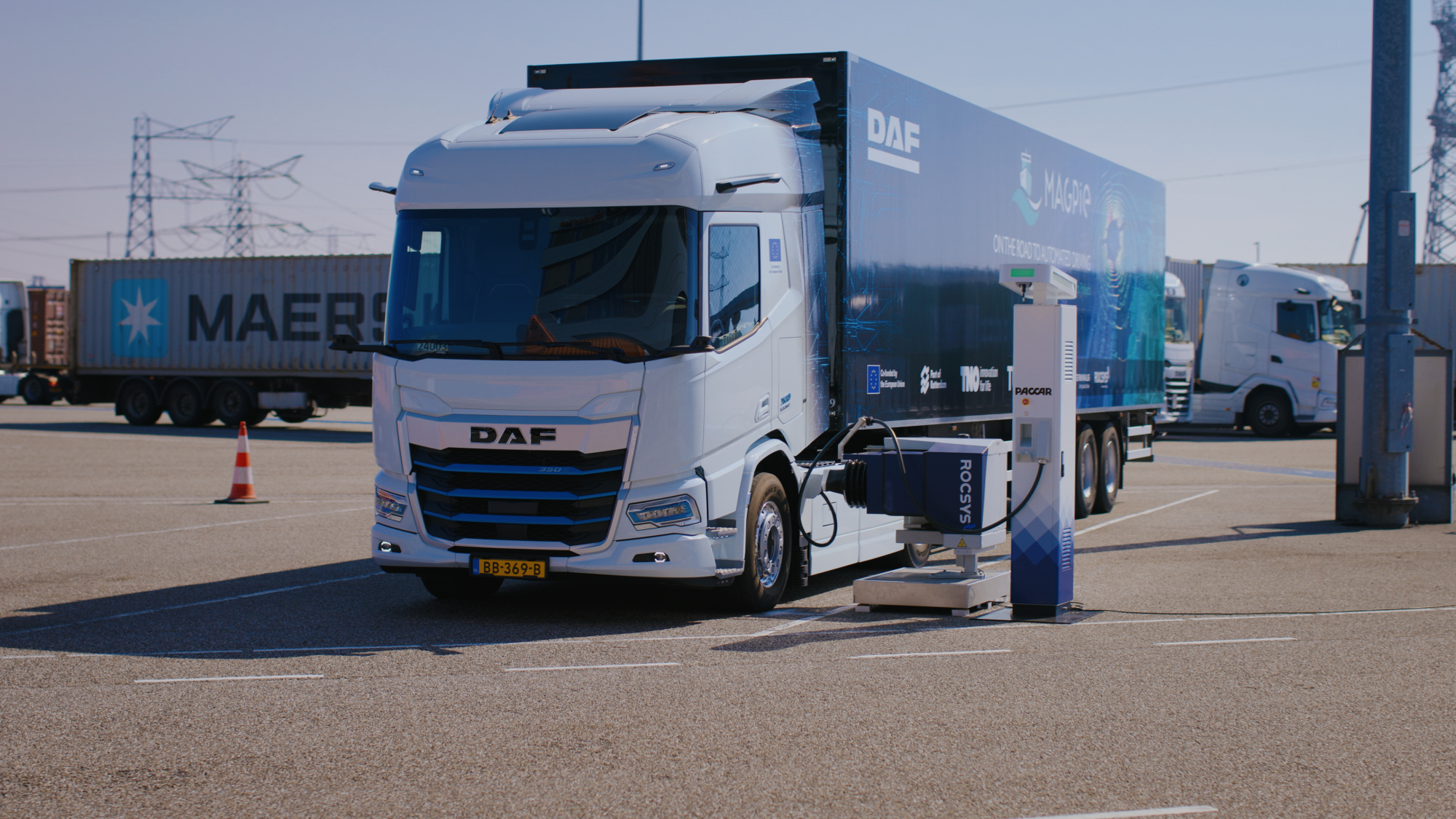 The DAF Trucks-Rocsys demo at the Port of Rotterdam. Source: Rocsys Rocsys' flagship deployment at APM Terminals in Rotterdam will enable port infrastructure to operate 24-7 without manual intervention. Rather than rely on personnel working in shifts to manage round-the-clock charging and operations, the robochargers are designed to handle the task autonomously, cutting costs by 30% to 40% compared to human labor. While ports are a natural early market, Rocsys is eyeing a much larger opportunity: tending to self-driving taxis. As autonomous car companies scale up, so too will their charging needs. In the US, Waymo now facilitates over 200,000 rides each week across Austin, Los Angeles, San Francisco and Phoenix, with each vehicle requiring up to four charges per day. Bouman believes the robotaxi boom is coming. "The last two years, we started to see this is going to take off big time in the US," he says. The other growth market is China, which has multiple startups operating across the country.  The ROC-1. Source: Rocsys Tesla prides itself on being vertically integrated — business jargon for taking ownership of much of its business — and thus is unlikely to be a customer. "But for Waymo and also all the ports and logistics, we would be the provider," Bouman said. For now, the idea of a Tesla robotaxi remains just as much a concept as the snake-bot charger prototype the company released footage of 10 years ago. But the company has said this will change soon — in June, it plans to launch a paid self-driving car service in Austin. While it's taken Tesla eons to turn its robo concepts into reality, this hasn't stopped the company from hyping fresh prototypes. Tesla's X account posted a video in January of an autonomous vacuum hoovering a Cybercab prototype. Tesla captioned the video: "This robot sucks." Until companies like Waymo or Tesla manage to roll out autonomous vehicles in more widespread fashion, the need for autonomous charging will remain limited. But Bouman is betting the transformation is inevitable, and that there will be a role for Rocsys to play. "The best charging experience," he says, "is the one you don't have." — By Marilen Martin and Craig Trudell  A customer viewing a new Super Duty pickup at a Ford dealership in Miami. Photographer: Eva Marie Uzcategui/Bloomberg Ford is preparing to raise prices on cars rolling off assembly lines starting next month if President Donald Trump doesn't deliver on the tariff relief he's hinted at for automakers. Without a major change in policies, "we anticipate the need to make vehicle pricing adjustments in the future, which is expected to happen with May production," Andrew Frick, president of Ford's gas-fueled and electric car units, said in a memo to dealers. Volkswagen's namesake brand, meanwhile, joined Ford, Hyundai and Stellantis in announcing it plans to freeze prices through next month.  Xpeng founder and chairman He Xiaopeng. Photographer: Lam Yik/Bloomberg Chinese EV maker Xpeng threw a global launch event for a flagship vehicle, the X9 minivan, in Hong Kong on Wednesday, hosting more than 800 journalists and electric cars owners from 30 countries and regions. Xpeng announced plans to localize production in Indonesia and set up an R&D center in Germany. "For Xpeng's globalization path, we believe that only through localization, such as local research and development, local services, local production and local sales, can we become truly international-facing," founder and CEO He Xiaopeng said in an interview with Bloomberg Television. | 







No comments:
Post a Comment