Tuesday, April 8, 2025

Is Elon Musk on his way out?

His tariff opposition follows Wisconsin loss
View in browser
Bloomberg

Elon Musk's spat with White House trade counselor Peter Navarro slipped into playground taunts today. Businessweek national correspondent Joshua Green is here to explain why this just adds fuel to the talk that Musk will be leaving Washington soon. Plus: Bloomberg Economics crunches the numbers on Trump's tariffs and sees pain ahead, and international travelers are rethinking US visits after visitors are detained at the border.

If this email was forwarded to you, click here to sign up.

It was only a week ago that Elon Musk suffered a political blow that put a scare in Republicans, single-handedly revived Democratic spirits and raised questions about how much longer the polarizing entrepreneur will last as a member of President Donald Trump's inner circle. Now more trouble is brewing between them as Trump's tariff war heats up.

Musk had staked $20 million and plenty of personal political capital on delivering Republicans a victory in a Wisconsin Supreme Court race that would determine partisan control of the body. Because the court is expected to address congressional redistricting, the winner could reshape the state's delegation, potentially tilting control of the US House of Representatives.

In the closing weeks of the campaign, Musk traveled to Wisconsin, donned a cheesehead and declared that the "future of civilization" was riding on the race's outcome. Although notionally there to boost the Trump-endorsed conservative candidate, Judge Brad Schimel, Musk, as is often his habit, made the race about himself, pulling stunts like handing out three $1 million checks.
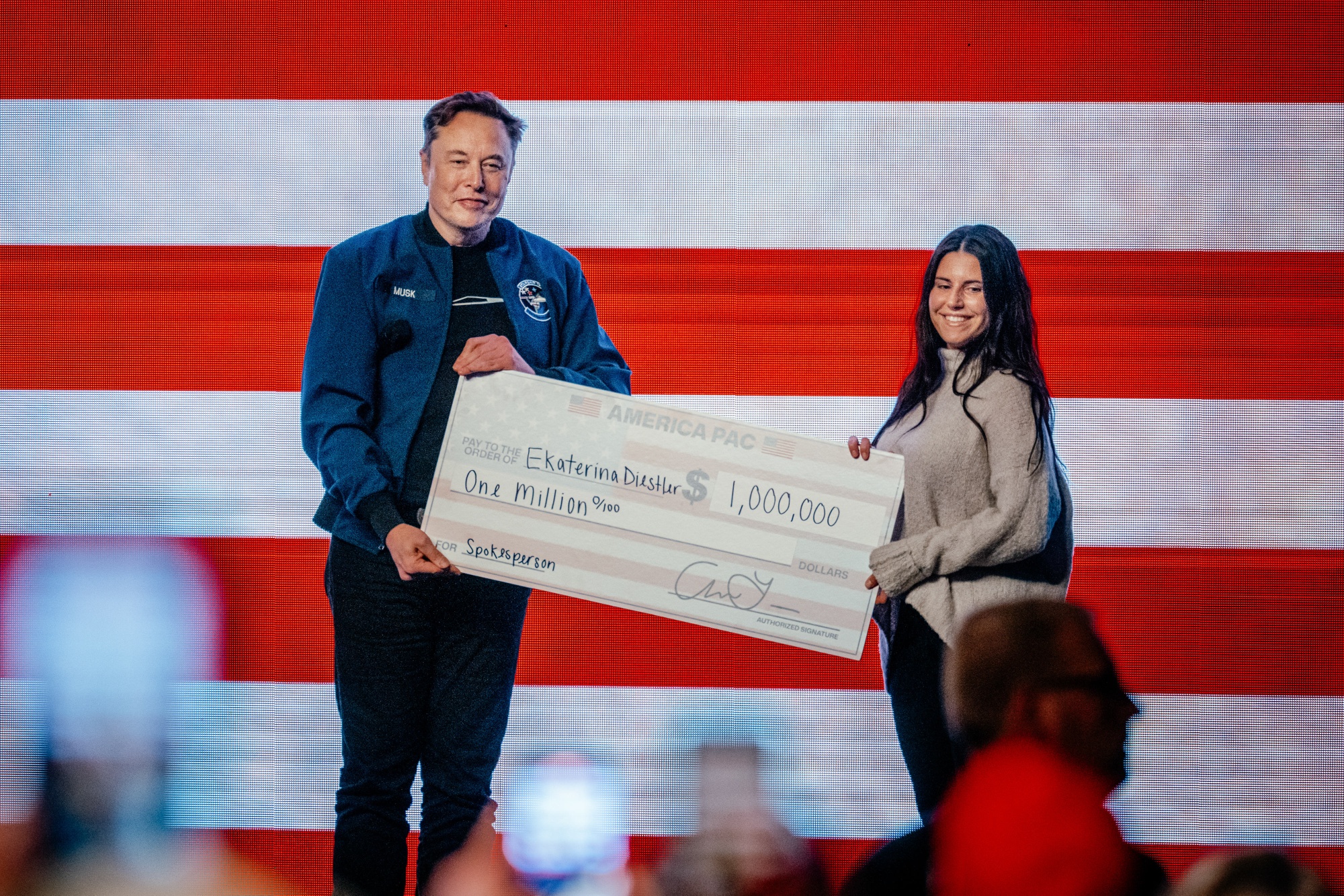
Musk with a prize winner at a town hall hosted by his America PAC on March 30 in Green Bay. Photographer: Jamie Kelter Davis/Bloomberg

It turned out badly for Musk when the liberal candidate, Susan Crawford, routed Schimel by 10 points. Democratic National Committee Chair Ken Martin called Musk "one of the least popular people in the country right now."

What many Republicans wonder is whether Musk will now be less popular—and influential—with the president. Steve Bannon, Trump's former chief strategist and a voluble Musk frenemy, suggested on the morning after the loss that he would. "It's a wake-up call," Bannon said. "Clearly he has become a rallying point for the opposition."

The buzz in Washington was that Trump, who hates losing, is tiring of the headaches and humiliations that are part and parcel of Musk's support. Politico reported that the president told members of his cabinet that Musk was on his way out.

Whether or not the billionaire is really in jeopardy was a topic of intense discussion in political circles—at least until Trump's new tariff regime sent global markets into a tailspin. Musk, who's hyper-obsessed with his public image, took to social media to counter the impression that he'd suffered a crippling humiliation. He reposted a tweet from his super PAC that showed video of Trump aboard Air Force One telling reporters, "I want Elon to stay as long as possible."

But Musk's political future isn't quite so clear cut. In the same interview, Trump indicated that his biggest funder was indeed ticketed for an exit. "I would say Elon will stay for a certain period of time," Trump said. "And then he's going to want to get back to his businesses full time." Musk's role as a special government employee is technically temporary, and by statute is meant to last just 130 days in a year.

In Washington, the time-tested method for surviving a rough patch is to stay quiet, keep your head down and wait for some fresh event to come along and capture the news cycle. And sure enough, the collapse of global equities markets provided just such a distraction.

But keeping quiet isn't in Musk's nature. He's long opposed tariffs, because they're harmful to his global car company, and over the weekend expressed his desire for a free-trade zone with Europe. His younger brother, Kimbal Musk, chimed in too, slamming the tariffs as "a permanent tax on the American consumer."

The Tesla CEO has also taken to X to publicly attack one of the architects of Trump's tariff plan, Peter Navarro, ensuring that he'll remain in the news. After Navarro responded on Monday by calling Musk "a car assembler" instead of a manufacturer, Musk posted today that "Navarro is truly a moron."

Trump doesn't like criticism—so the split on trade will only add to the impression that the first buddy's days in his inner circle may be numbered.

Related: The Musk Associates Running the Government

In Brief

  • US stocks rallied at the open today after a three-day selloff that wiped out more than $5 trillion of value.
  • Consumers are stockpiling imported goods from iPhones to Italian olive oil before Trump's tariffs hit.
  • Meta is expanding protections for teen users of Facebook, Instagram and Messenger, including restrictions on live videos and direct messages.

Brace for Tariffs' Impact

Photographer: Jeff Bark for Bloomberg Businessweek

In Gravity's Rainbow, Thomas Pynchon's sprawling World War II epic, a rocket engineer testing his latest design stands at the exact point it would land if everything worked perfectly. His reasoning: The complexities and uncertainties in the new technology are so great that a bull's-eye is the least likely outcome.

Economists attempting to forecast the impact of President Donald Trump's "Liberation Day" tariffs might arrive at a similar conclusion. There's policy uncertainty—who knows if tariffs will be kept in place or negotiated away? Economic uncertainty—who knows whether producers or consumers will bear a larger share of the cost? And modeling uncertainty—who can estimate the impact of massive tariffs when there's no recent experience to guide us?

Uncertainty cubed. What to do? Bloomberg Economics' approach is to take a variety of approaches. To gauge the impact of tariff hikes on US growth and inflation, we used results from a Federal Reserve study conducted during Trump's first term. To estimate the hit to China, European countries and other nations, we employed a global model from the World Trade Organization. Plus we looked at data on both imports and inflation to see how Trump's moves are already affecting the economy.

The results show that the historic tariff hike is set to have a historic impact, writes Tom Orlik in his latest column for Businessweek: Trump's Tariffs Leave Economists Fixated on One Word: Stagflation

Stories About Border Woes Deter Travelers

Illustration: James Clapham for Bloomberg Businessweek

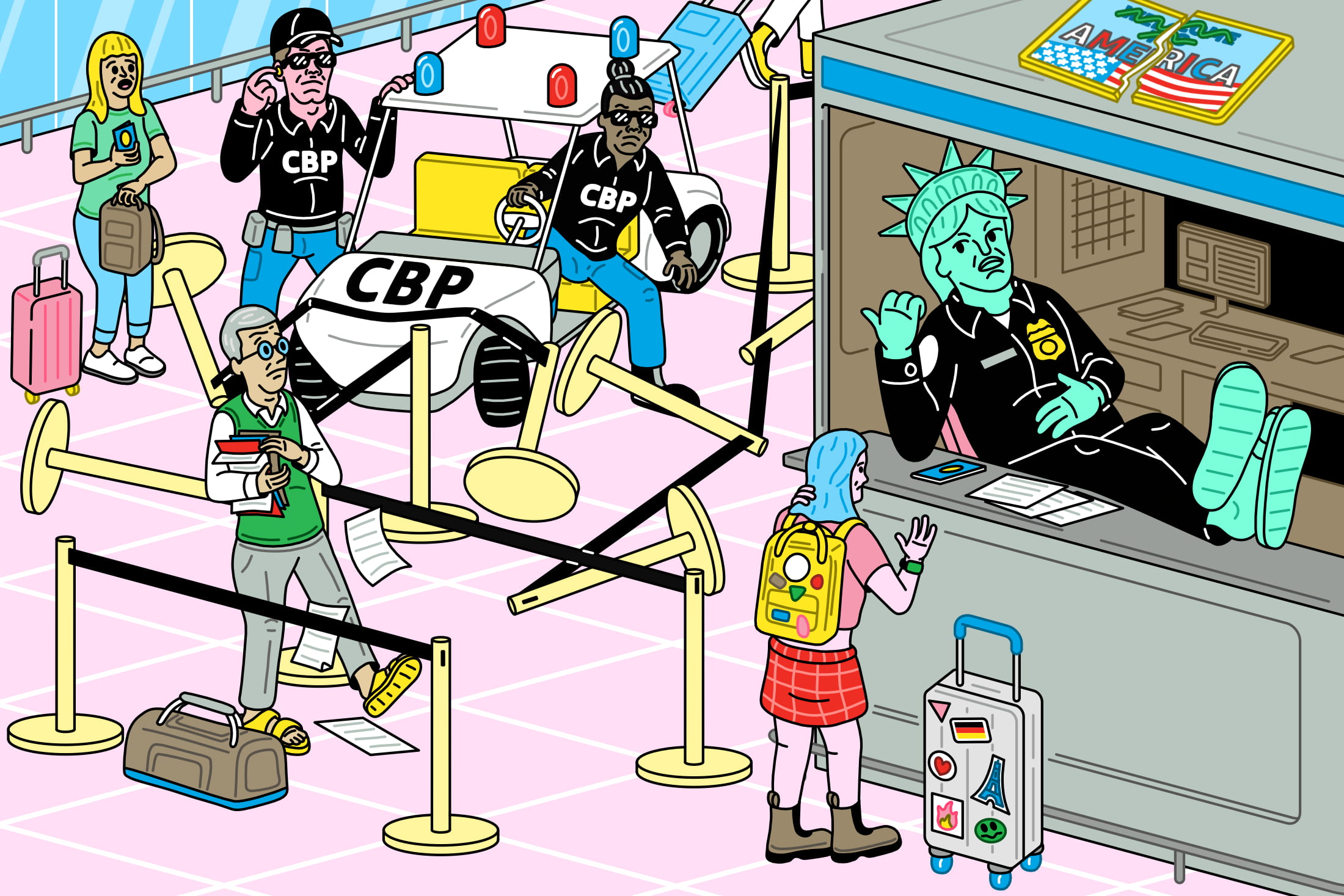
Days into Trump's second term, a German woman crossing into America from Mexico was held by US Immigration and Customs Enforcement for more than a month. A few weeks later, a Canadian actress was kept for 12 days in detention centers on the southern border after bureaucratic troubles over a work visa. A French scientist on his way to an astronomy conference was detained at the airport in Houston for a day and ordered to return home.

Friction at the US border, especially disagreements over paperwork, isn't strange on its own, say overseas diplomats. But the harshness and length of the detentions in the brief time since Trump returned to Washington are bizarre, they say. So are the headlines, which the new administration either doesn't mind or has been unable to control. "The border agencies are under new orders, so they're a bit stricter," says one European consular official who asked not to be named. "But it does seem as if the American government wants to send a warning."

A warning about what? US Customs and Border Protection says a reduction in illegal crossings has freed up its law enforcement officers to do more "vetting" at the border. "Lawful travelers have nothing to fear from these measures," says Hilton Beckham, assistant commissioner for public affairs at CBP. "However, those intending to enter the US with fraudulent purposes or malicious intent—don't even try."

Michael Scott Moore writes that early signs suggest even well-meaning tourists are staying away: World Travelers Are Rethinking Vacation Plans to the US

Apple Shows a Bruise

19%
That's how much Apple shares have dropped since last week, in the worst three-day stretch for the company since 2001. The sharp selloff illustrates investor skepticism about its ability to navigate Trump's tariffs on China, India and Vietnam—countries all critical to the iPhone maker's supply chain.

Age of Uncertainty

"China becomes the big winner in all of this, because countries are going to look and they're going to say, 'Well, who can we deal with now? The Americans have become so utterly unpredictable.' China, ironic as this is, is, relatively, looking like a good global citizen at the moment."
Edward Alden
Senior fellow and expert in global trade at the Council on Foreign Relations
Investors are trying to reprice risk in an age of uncertainty inflamed by dueling US and Chinese visions for the future.

More From Bloomberg

Like Businessweek Daily? Check out these newsletters:

  • Markets Daily has what's happening in stocks, bonds, currencies and commodities right now
  • Supply Lines follows the trade wars, tariff threats and logistics shocks that are upending business and spreading volatility
  • FOIA Files goes behind the scenes with Jason Leopold to uncover documents that have never been seen before
  • Working Capital analyzes trends in leadership, management and the art of career building
  • Bloomberg Pursuits is your weekly guide to the best in travel, eating, drinking, fashion, driving and living well

Explore all Bloomberg newsletters.

Follow Us

Like getting this newsletter? Subscribe to Bloomberg.com for unlimited access to trusted, data-driven journalism and subscriber-only insights.

Want to sponsor this newsletter? Get in touch here.

You received this message because you are subscribed to Bloomberg's Businessweek Daily newsletter. If a friend forwarded you this message, sign up here to get it in your inbox.
Unsubscribe
Bloomberg.com
Contact Us
Bloomberg L.P.
731 Lexington Avenue,
New York, NY 10022
Ads Powered By Liveintent Ad Choices

No comments:

Post a Comment

đŸ›‘ How China Attacks America

One weapon, one response — and dozens of stocks exposed ͏  ͏  ͏  ͏  ͏  ͏  ͏  ͏  ͏  ͏  ͏  ͏  ͏  ͏  ͏  ͏  ͏  ͏  ͏  ͏  ͏  ͏  ͏  ͏ ...