| There are elections today in Florida that will send two new members to Congress, but Joshua Green is closely watching a race farther north. So is Elon Musk. Plus: 10 companies to watch right now, and how airlines have just about mastered serving burgers in flight. If this email was forwarded to you, click here to sign up. Tonight, political attention will shift to Wisconsin's Supreme Court election, which is technically nonpartisan but will in reality determine whether the court maintains its 4-3 liberal majority or flips to conservative control. The candidates on the ballot are Judge Susan Crawford (liberal) and Judge Brad Schimel (conservative). But over the past several weeks, the contest has turned into a referendum on someone who's neither a judge nor a Wisconsinite: Elon Musk. Politically speaking, Wisconsin is one of the most evenly balanced states, so the Supreme Court race was always going to draw interest. Most people in politics assumed it would be a useful measure of party strength in the new Donald Trump era and an early verdict on how voters are feeling about his chaotic second term as president. "If you'd asked four weeks ago, I'd have said this race was all about how well each party has mobilized its base voters," says Charles Franklin, director of the Marquette Law School Poll. Then Musk got involved. As perhaps the most polarizing figure in US politics today, Musk made a noisy entrance that guaranteed Wisconsin's election would be nationalized. And indeed it has: The Milwaukee Journal-Sentinel found that more than 100,000 donors from all 50 states have sent money to the two candidates, though none more than Musk, the world's richest man. He and his allied groups have contributed about $20 million, shattering previous spending records in judicial elections. Lest anyone miss the news of his money bomb, Musk showed up at a rally on Sunday in Green Bay and handed out giant Publishers Clearing House-style checks for $1 million, after a court declined to take up a lawsuit by the state attorney general concerning the giveaways. "The reason for the checks," he explained, is "really just to get attention." Well, he's got it. Last fall, I wrote in Bloomberg Businessweek about how Musk had displaced the Koch brothers as the great supervillain in Democratic minds and started popping up in political attack ads. That was before he'd emerged as Trump's top adviser, chief henchman and field general in the DOGE assault on government. Today, Democratic hatred of Musk is far more intense and widespread, to the point that liberals are protesting at Tesla dealerships—and sending tons of money to Wisconsin to counter his influence there. As University of Wisconsin at Madison political scientist Barry Burden illustrated on Bluesky, the result has been a tidal wave of spending on the Crawford-Schimel race: 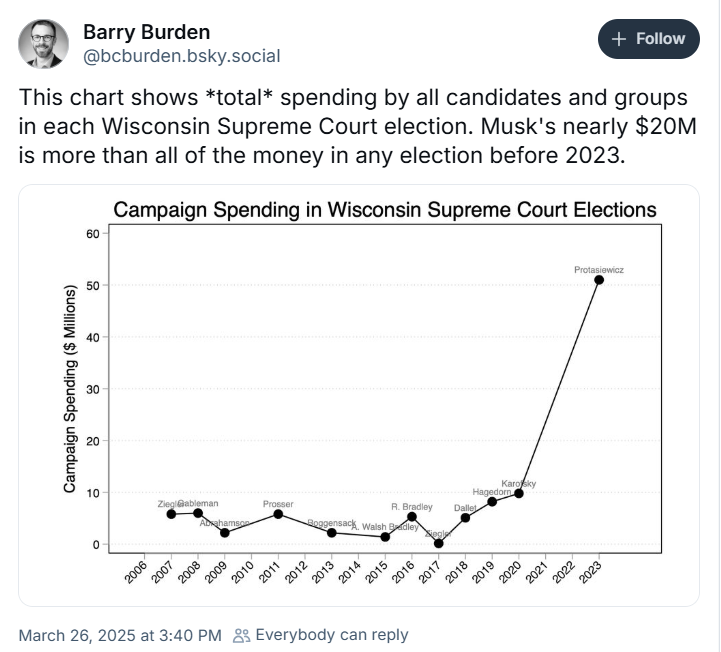 Franklin says this enormous influx of political money tied to Musk's involvement has had a distorting effect on the election. "Musk has suddenly emerged as a prominent figure in the race, not just because of his large financial contribution but because Democrats have seized on it and made him the target of most of their negative advertising," he says. "The tagline is, 'Musk is trying to buy the Supreme Court.' That's changed the nature of the race." The most recent Marquette Law School Poll sheds light on why both parties are so eager to turn this election into a referendum on Musk. On one hand, Republican voters in Wisconsin give Trump sky-high approval ratings (92%), even as Democrats virulently disapprove of him (97%). So Republican officials in Wisconsin view Musk's willingness to fund millions of dollars of ads and to pay workers stumping for the Trump-backed candidate as a godsend. Democrats, on the other hand, are more focused on what the poll says about Musk's popularity in Wisconsin. Among Democrats, sentiment toward Musk is every bit as negative as it is toward Trump, with 97% disapproving of him. But Republicans' feelings toward Musk, while warm overall, aren't nearly as positive as they are for Trump, with 80% having a favorable view of the high-profile entrepreneur. This has convinced Democrats that Musk is a juicier target in the Supreme Court race than Trump, who, after all, won the state by about 30,000 votes in November. In a strange way, tonight's election results should still provide plenty of interesting and useful information about the current state of our politics. It just won't necessarily tell us a great deal about the state of play in Wisconsin or about issues like abortion or congressional redistricting that seemed to be the dominant themes in the race until you-know-who got involved. But we will learn plenty about the relative popularity of Musk. "Four weeks ago, I'd never have said this race was a referendum on Trump or Musk," says Franklin. "But he—Musk—has made it one. And Democrats have accepted the challenge." | 








No comments:
Post a Comment