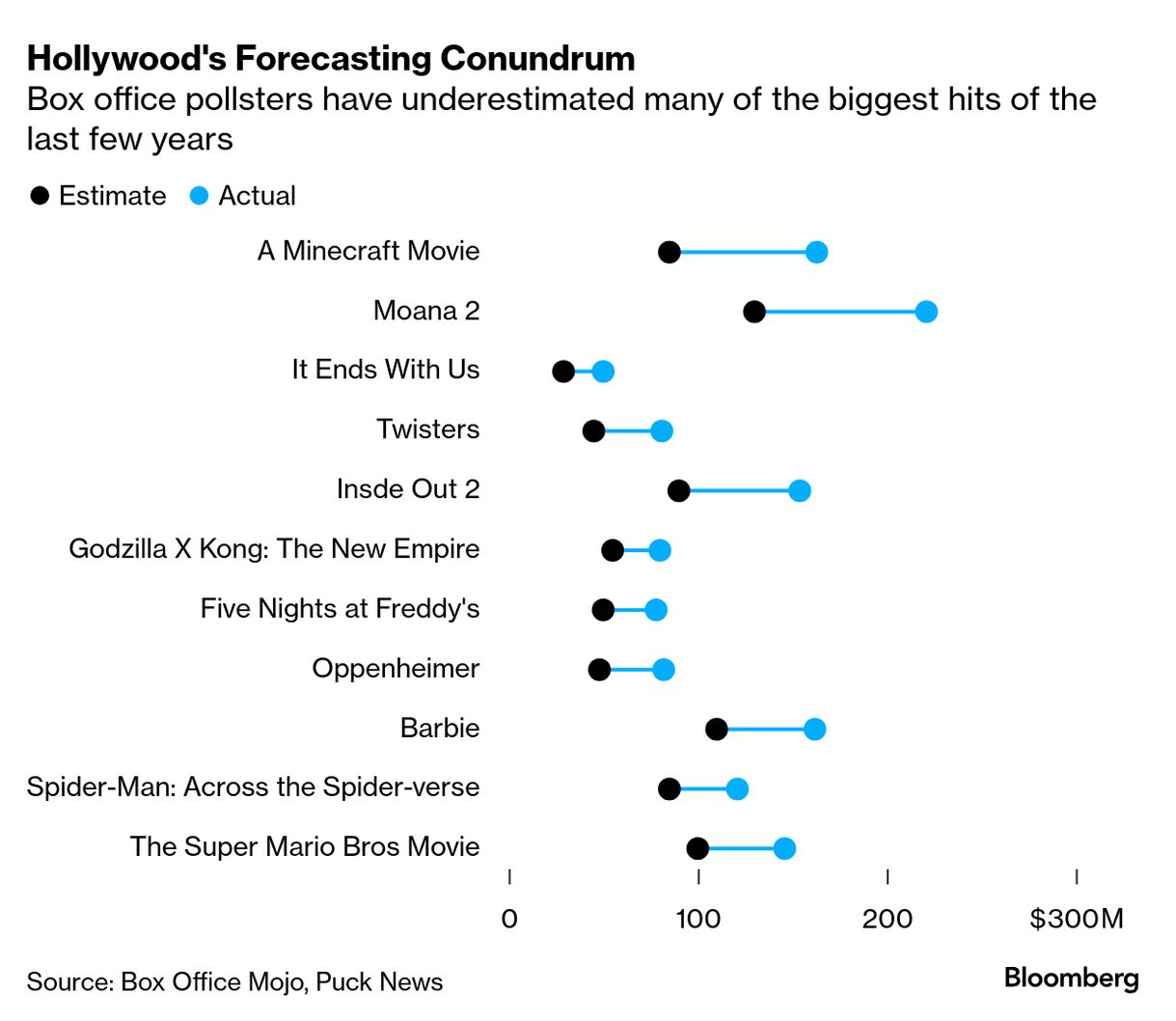
| Less than a week before the release of A Minecraft Movie, experts projected the film would gross about $65 million over its opening weekend. As more data trickled in, some increased their forecasts to $85 million or even $100 million. Nobody anticipated it would top $160 million in the US and Canada, the biggest debut of the year. The performance delighted theater operators, which are looking for any good news for the struggling film business. But its success also prompted a follow-up question. How did everyone get it so wrong? A Minecraft Movie is just the latest blockbuster that forecasters missed by a huge margin. Just last year, Moana 2, It Ends With Us, Twisters and Inside Out 2 all exceeded expectations by quite a bit, as did The Super Mario Bros. Movie and Barbie in 2023 and Minions: The Rise of Gru in 2022. Inside Out 2 opened to $154 million — $54 million more than the average of estimates. "Over the last couple of years, the big movies, when they go big, they go big at a level we aren't really predicting," said Ray Subers, a senior vice president in charge of film at National Research Group, the leader in box-office forecasting. "We've seen more instances of titles that radically overperform estimates than we did historically." Forecasting movies is an inexact science. NRG polls about 900 moviegoers three times a week and modifies its forecasts based on comparisons to similar films from the past and reviews. NRG issues seven forecasts for films starting almost a month before their release. The projections are designed to help studios fine-tune their marketing campaigns in the weeks before a movie is released. It will tell them if they are missing a certain age group, gender or race – or whether a title is doing so poorly they should just cut their losses. Movie studios care a lot about how the media frame these numbers. They all try to influence what gets published, managing projections so that the results look like they met or exceeded expectations. If a film is publicly perceived to be a failure, the average moviegoer is less likely to buy a ticket. Many executives feel the tools used to track box-office performance are in decline. They have lost the ability to understand viewers, especially younger ones. The data don't support this conclusion. On the majority of movies, forecasts land within a few million dollars of actual sales. The average margin of error on the biggest titles has ranged from 15% to 25% for many years. The first quarter was NRG's best in several years, according to Subers. The Quorum, another tracking service, said it is accurate more than 80% of the time. But certain kinds of hits are outperforming by more than ever before. "We are not good at tracking family films," David Herrin, founder of The Quorum, told me. Movies that are especially popular with women, like It Ends With Us and Barbie have also proven difficult. Experts identify a few reasons, starting with the sorry state of the industry. The business has been so sluggish since the onset of the Covid pandemic that researchers have been extra conservative in their forecasts. NRG lowballed Deadpool & Wolverine, in part, because no movie had opened to more than $190 million since before the pandemic. It became the first, hitting $211 million. Family movies are especially difficult because it is harder to measure the sentiment of an 8-year-old than that of an adult or even a teen. Firms often need to rely on what their parents say. Perhaps the biggest wild card is how much technology has accelerated word of mouth. Smartphones and social media enable movies to gather momentum more quickly than they once did. Studios used to talk a lot about word of mouth. A movie might have a solid opening weekend, and then the positive chatter would lead to sustained success in subsequent weeks. People talked about it at the office or at a bar. Much of that conversation now happens online – at least among the young. A Minecraft Movie was most popular with men under the age of 25. The movie grossed $11 million in previews Thursday night – a good number, but not one that normally would have led to a $160 million weekend. Fueled by TikTok memes and activations within the video game, interest in the film ballooned over the weekend. Warner Bros. isn't going to complain about the tracking. The movie is a hit. Herrin even suggested that the low initial estimates helped ecnoruage Warner Bros. to stage an effective late marketing blitz. But all the researchers are studying their models, hoping to improve their projections for big hits in this new post-pandemic era. The best of Screentime (and other stuff) | CBS loses Jeopardy and Wheel of Fortune – for now | Sony won the right to distribute Jeopardy and Wheel of Fortune in a court victory that could cost CBS millions of dollars a year. While Sony produces the shows, CBS has distributed them under a deal signed more than 40 years ago. Television executive Roger King secured the rights to distribute Jeopardy and Wheel of Fortune from Merv Griffin. Griffin made the shows and King, whose company was later acquired by CBS, syndicated them to TV stations all over the US. King got great terms, securing a 35% share of the sales – above the market average. Sony, which owns Merv Griffin Enterprises, has been unhappy with the arrangement for some time and sued CBS last year, accusing the company of failing to maximize revenue from the shows. CBS denied the allegations. This ruling isn't the final straw. CBS will appeal. But, in the meantime, Sony secured a big victory. The No. 1 movie in streaming is…Moana 2. The sequel thumped Netflix's Electric State even though millions of people already saw it in theaters. We probably haven't talked enough about Electric State, one of the biggest bombs in recent memory. Netflix spent more than $300 million on a movie that wasn't even its biggest title of the first quarter. Deals, deals, deals - India's top streaming service said it passed 200 million subscribers less than a month after it eclipsed 100 million.
- Formula 1 is struggling to find a taker for its US TV rights – at least at the current asking price.
- John Malone is stepping down as a board member at Warner Bros. Discovery. RIP to the rumors that he'd grown dissatisfied with CEO David Zaslav. Zaslav got paid $51.9 million last year – a raise despite lower sales and earnings.
- Ari Emanuel is spending more than $1 billion to buy tennis tournaments from his own company.
Hacks is back. It remains the best comedy on TV. If you don't already receive this newsletter, please sign up here. | 








No comments:
Post a Comment