Thursday, March 20, 2025

Higher ed on the brink

How are students reacting?
View in browser
Bloomberg

"What's your major?" might be the most common conversation starter on college campuses. It's also a metric for seeing how much universities have changed over the past 50 years. Check out the graphic by Dorothy Gambrell below as Reyhan Harmanci describes Bloomberg Businessweek's new package on higher education. Plus: Another "China Shock" is here, and why we don't know what AI will do for productivity yet. If this email was forwarded to you, click here to sign up.

Escalating costs, controversial protests and the lingering effects of the Covid-19 pandemic have had US colleges in a tailspin. And things are only getting worse.

The biggest threats are now coming from Washington, as President Donald Trump's potential funding cuts threaten to upend research, freeze hiring and roil student aid. Trump is even expected to sign an order today to wind down the Department of Education as much as possible. Meanwhile, campuses—long the epicenter of the culture wars—are dealing with MAGA influence, inflation and AI. As more students question whether degrees are worth the debt, college is at a crossroads.

One way to see how those trends have affected students is to look at their chosen majors. Business degrees remain on top, and the popularity of education has fallen greatly. Engineering, which took a dip at the turn of the millennium before shooting up to near the top, has been on a decline as of late. Physical science, math and law enforcement had brief moments cracking the top 10 over the past few decades before dropping off. Health professions, though, the sea-green line, now rest at No. 2. Seems like death and taxes remain the inevitables.
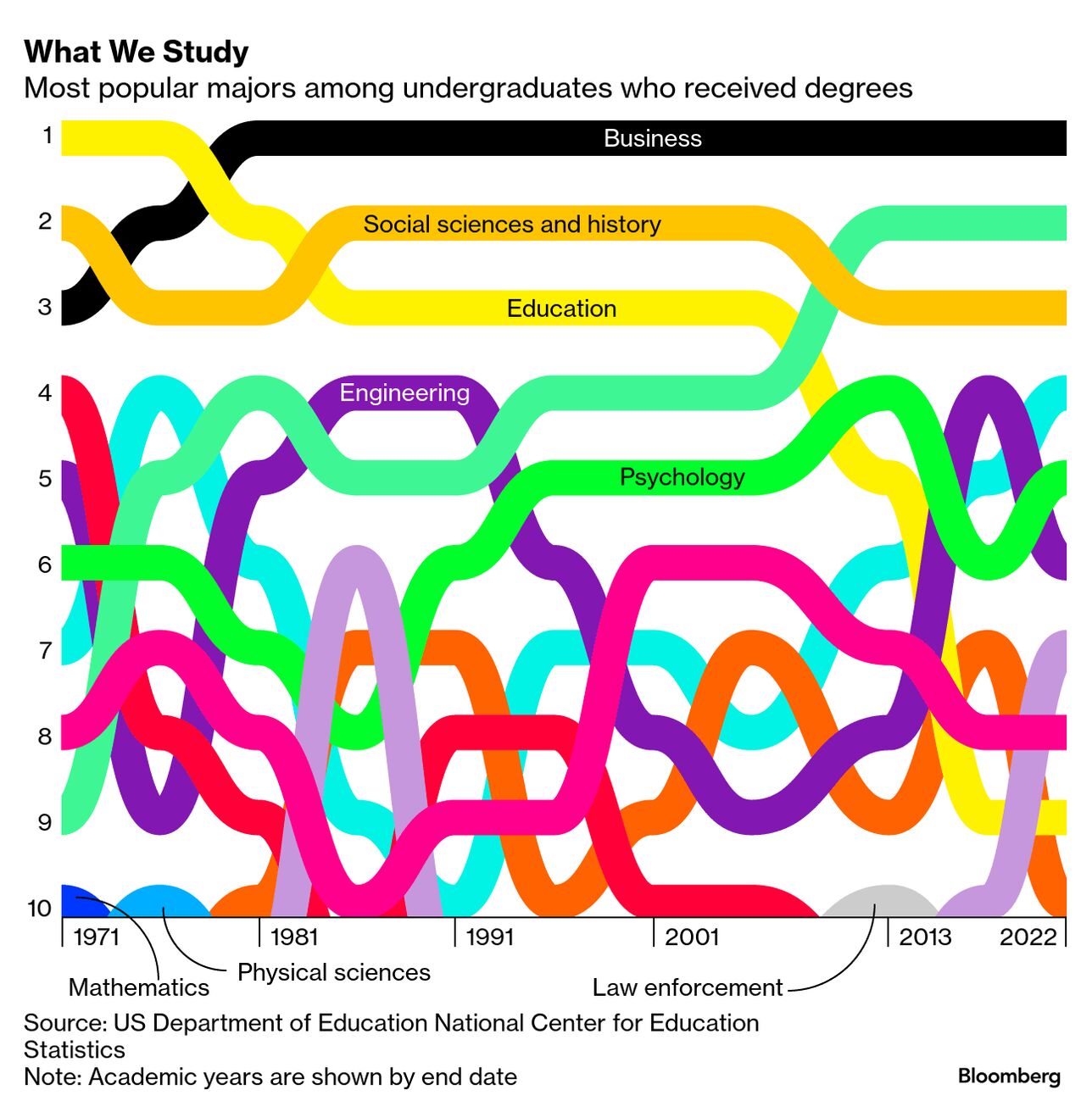
CHART: What We Study: Most popular majors among undergraduates who received degrees

If this mess of lines seems chaotic, well, that chaos is reflected back on campuses. In April's issue, Bloomberg Businessweek takes a long look at the state of play. We gathered five university presidents from very different institutions to talk about their challenges and the shaky case for optimism. We looked at Austin, the iconic home of "slackers," which has been ground zero for the Texas state government's attempt to strip institutions of "wokeness" in favor of more conservative colleges. We did the cost-benefit analysis of a four-year degree (still worth it) and examined a submerged giant in higher ed—the College Board, which brings in $1 billion annually in testing and curriculum revenue. And just because it's not all a bummer, we went to a community college system that seems to be improving its offerings, if only it can escape cost-cutting measures. Through it all, the kids themselves, trying to sort through this maze to get a degree, seem to be all right.

In Brief

  • US Treasuries extended gains triggered by the Federal Reserve as markets took reassurance that policymakers are still on a path toward lower interest rates.
  • France's Emmanuel Macron is heading for a clash with Donald Trump over his push to help Ukraine.
  • Tesla recalled all the Cybertrucks it produced and sold in the first 15 months they've been on the US market over a safety issue it's having trouble resolving.

Trump Tariffs and a 'China Shock'

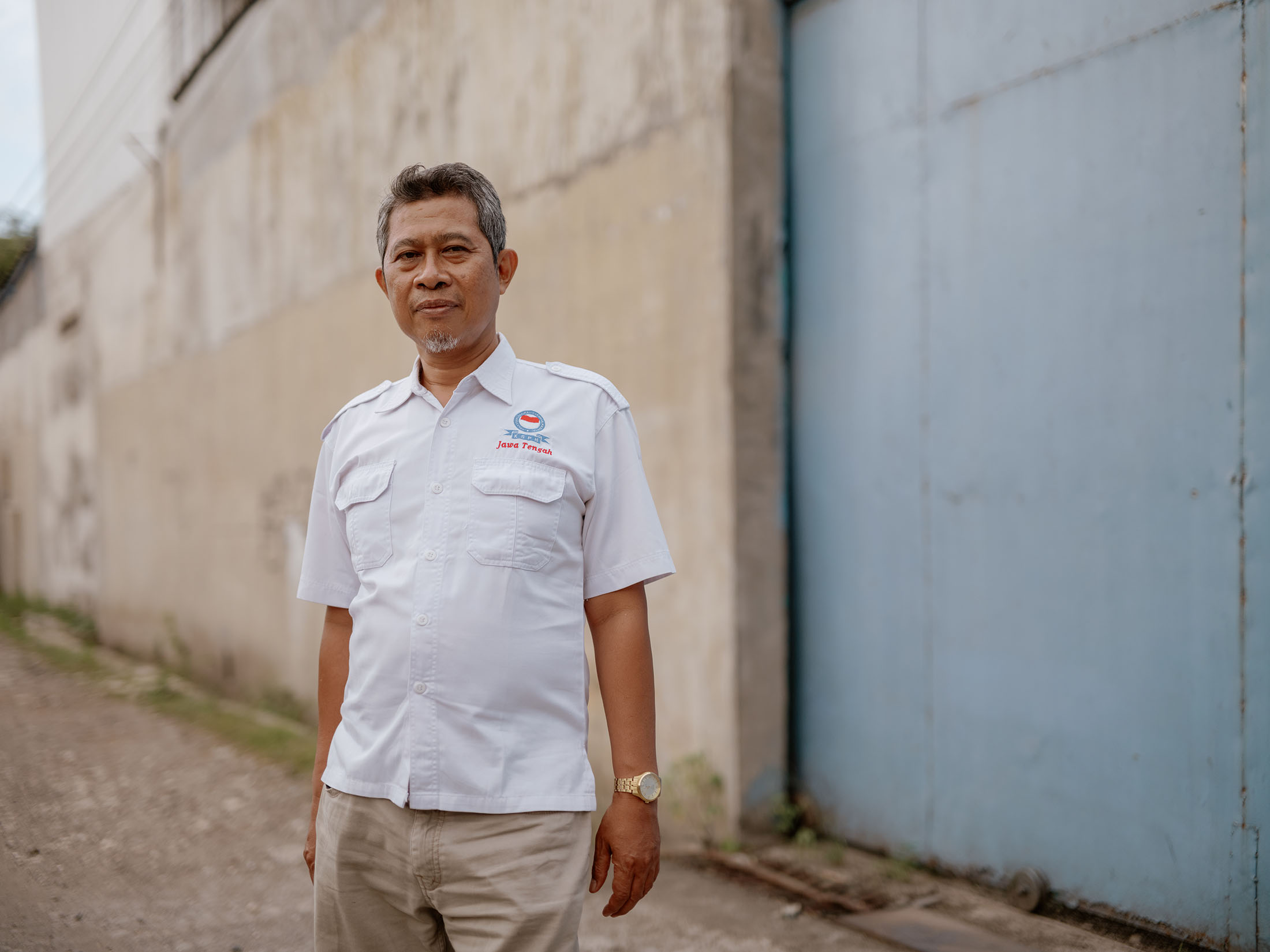
Hariyanto, who was furloughed from his job at an Indonesian garment factory, is leading a legal fight to receive back pay and severance. Photographer: Muhammad Fadli/Bloomberg

Near the Indonesian city of Surakarta, a onetime royal capital on the island of Java that's long been known for producing elaborate fabrics, dozens of once-bustling garment factories sit empty behind locked gates.

At a coffee shop not far from the plant where he was employed for more than three decades, 53-year-old Hariyanto blamed cheap imports from China for the economic devastation. One of about 1,500 employees furloughed at an apparel maker last year, the former low-level manager is now leading a legal fight to get back pay and severance from the company, which is financially stressed and looking to sell off assets.

"I'm worried China could pressure the government to accept the current conditions," Hariyanto, who like many Indonesians goes by one name, said on a scorching day in February. "If a company goes down, it's more than just those they employ who feel it," he added. "It impacts every part of the community."

Southeast Asia's biggest economy lost roughly a quarter-million jobs in the textiles and apparel industry over the last two years, according to the Indonesia Fiber and Filament Yarn Producer Association, which has estimated another half-million are at risk in 2025—effectively wiping out 1 in 4 jobs in the sector in a matter of years. That pace is considerably faster than the "China Shock" that claimed as many as 2.4 million US jobs from 1999 to 2011.

Katia Dmitrieva, Philip Heijmans and Prima Wirayani write about how US tariffs could make things worse: A New 'China Shock' Is Destroying Jobs Around the World

Does AI Save Time? Or Steal It?

Photographer: Cydney Cosette for Bloomberg Businessweek; Prop stylist: Audrey Davis

"Time is money" is a well-worn phrase in the corporate world. Like many other clichés, it's often used yet rarely taken seriously. But in the context of artificial intelligence and its effects on economic productivity, time—and more specifically, time savings—is becoming one of the most important measures of whether the huge investments in the technology will pay off.

Any technology's potential to lift living standards depends on its ability to drive improvements in what economists term total factor productivity—that is, getting more value out of all the resources used in the production of goods or services. Productivity has become a key preoccupation of business leaders and policymakers alike, because its growth has slowed substantially in recent decades, even as technological change appears to be progressing astonishingly fast.

Although almost every week brings a new AI model with startling capabilities, and the corresponding expectation that it will help companies improve their workflows or services, evidence of the advertised efficiency gains isn't showing up in the economic statistics so far. Surveys suggest plenty are trying out AI. A recent US Federal Reserve Board overview of business surveys found 20% to 40% of workers were doing so. Another study found that the rate of adoption among companies in the European Union averaged 13.5%.

Diane Coyle writes in a column for Businessweek about the need for better data: Why It's So Hard to Measure AI's Effects on Productivity

Related: An AI Startup Couldn't Beat Microsoft. So It Joined Them

A Florida Splash

$450 million
That's how much Oracle billionaire Larry Ellison, the world's fifth-richest man, has spent on real estate in the Florida town of Manalapan since 2022. His purchases are fueling a real estate boom in the town of just over 400 people and adding to the flood of wealth that has rippled across South Florida since the pandemic.

Standoff in Caracas

"It's become a sword of Damocles hanging over María Corina's head. In a way they're saying, 'If tomorrow you try something extreme, we will, too.'"
Benigno Alarcón
Director of the political studies center at Andrés Bello Catholic University in Caracas
Members of Venezuela's opposition are trapped in an Argentine embassy, living on rainwater and sardines, as government forces stand watch. Read the full story here.

More From Bloomberg

Like Businessweek Daily? Check out these newsletters:

  • Business of Space for inside stories of investments beyond Earth
  • CFO Briefing for what finance leaders need to know
  • CityLab Daily for today's top stories, ideas and solutions from cities around the world
  • Tech In Depth for analysis and scoops about the business of technology
  • Green Daily for the latest in climate news, zero-emission tech and green finance

Explore all Bloomberg newsletters.

Follow Us

Like getting this newsletter? Subscribe to Bloomberg.com for unlimited access to trusted, data-driven journalism and subscriber-only insights.

Want to sponsor this newsletter? Get in touch here.

You received this message because you are subscribed to Bloomberg's Businessweek Daily newsletter. If a friend forwarded you this message, sign up here to get it in your inbox.
Unsubscribe
Bloomberg.com
Contact Us
Bloomberg L.P.
731 Lexington Avenue,
New York, NY 10022
Ads Powered By Liveintent Ad Choices

No comments:

Post a Comment

🚨 3 Gov’t Stakes in 90 Days. Here Comes #4.

The next government-backed move may already be visible. ͏  ͏  ͏  ͏  ͏  ͏  ͏  ͏  ͏  ͏  ͏  ͏  ͏  ͏  ͏  ͏  ͏  ͏  ͏  ͏  ͏  ͏  ͏  ͏  ͏  ͏  ͏  ͏...