Friday, May 31, 2024

ETF IQ: Ticker shortage

The good ones are taken.
by Katie Greifeld

Welcome to ETF IQ, a weekly newsletter dedicated to the $12 trillion global ETF industry. I'm Bloomberg News reporter and anchor Katie Greifeld

What's In A Name?

Securing a catchy ticker can be a make-or-break mission for a new fund. That's getting harder to do in the $9 trillion US exchange-traded fund industry.

With 3,500 US-listed ETFs and counting, there are only so many computations to use that are ideally clever and relate to a fund's strategy. While the oldest ETFs — think SPY and QQQ — have three-character tickers, over the last 15 years or so, four-character tickers have dominated new launches, according to a recent Bloomberg Intelligence report. 

The dearth of strong tickers is particularly apparent in the single-stock ETF arena, which has exploded in size over the past two years. 
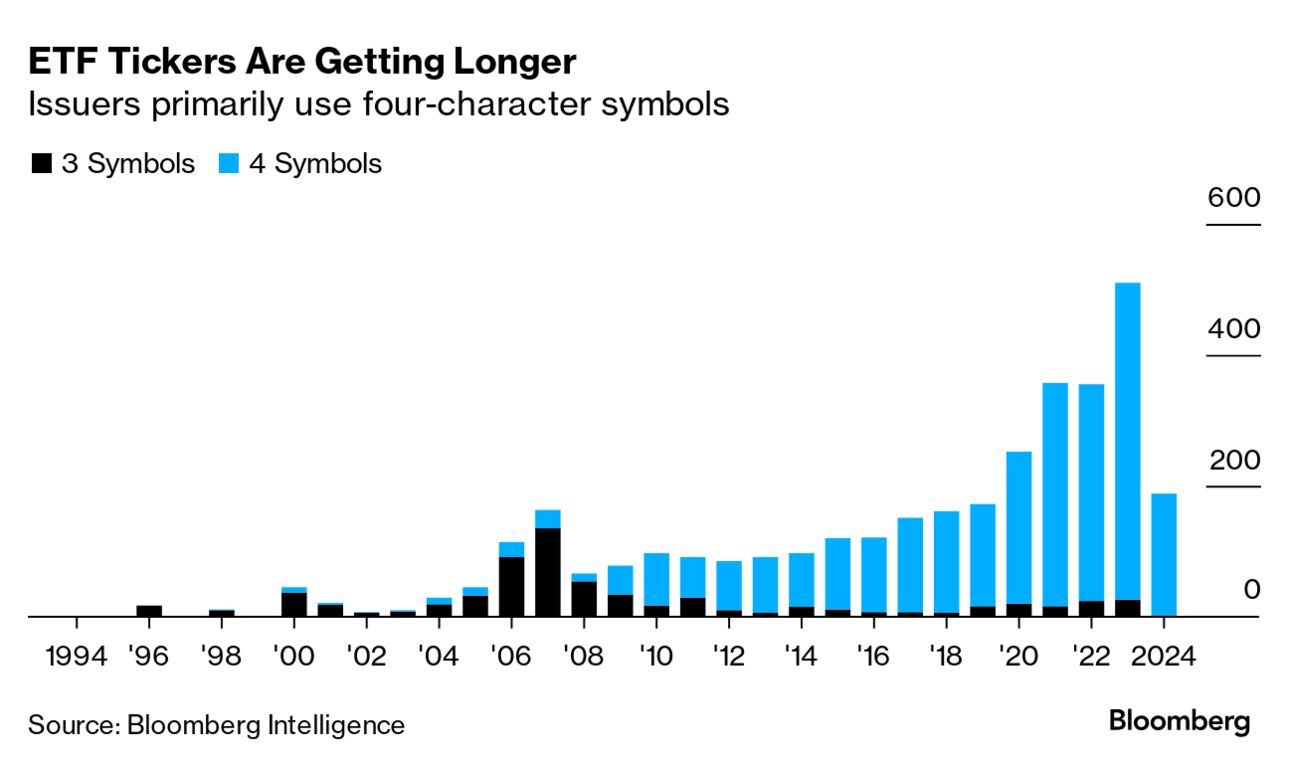
Source: Bloomberg Intelligence

"I think one place we're seeing a shortage is the single names. There's twelve ETFs built off Tesla, there's only so many derivations of TS-something, or Nvidia, or something like that," Tidal Financial Group's Michael Venuto said on Bloomberg Television's ETF IQ this month. "It's harder and harder to find the tickers that have a vowel, that's a word that resonates with people and tells the story in four letters."

While buzzy tickers are fun, they're also serious business. Research shows that stocks with tickers that are actual words tend to enjoy lower spreads and greater liquidity. As I reported back in 2021, there's a shadow market of sorts around the hottest tickers. 

So where do ETF tickers evolve from here? Currently, US exchanges have a four-character maximum for tickers — but that could change.

"We've gone from three characters to four, maybe it goes to five or maybe you put in some numbers as well," GraniteShares chief executive officer Will Rhind said on Bloomberg Television's ETF IQ this week. "That's obviously something for the exchanges to consider. But if you look at those really important tickers, there's a premium." 

Take My Money

Speaking of GraniteShares and single-stock ETFs, the firm's 2x Long NVDA Daily ETF — which trades under the ticker NVDL — is posting some crazy numbers. 

The fund, which offers twice the daily return of AI darling Nvidia Corp., has surged more than 350% over the past year and saw a record $4.7 billion in trading volume last week. That's translated into nearly $900 million in year-to-date inflows. 

That makes sense, of course: flows should intuitively follow performance. What's more interesting is that investors seem just as happy to shovel money at leveraged funds that are doing terribly. 

You can see that within the GraniteShares lineup. NVDL's foil fund, the GraniteShares 2x Short NVDA Daily ETF (ticker NVD), has plunged by nearly 84% on a total-return basis in 2024 — and yet, the ETF is still sitting on net inflows of about $80 million.

Bloomberg

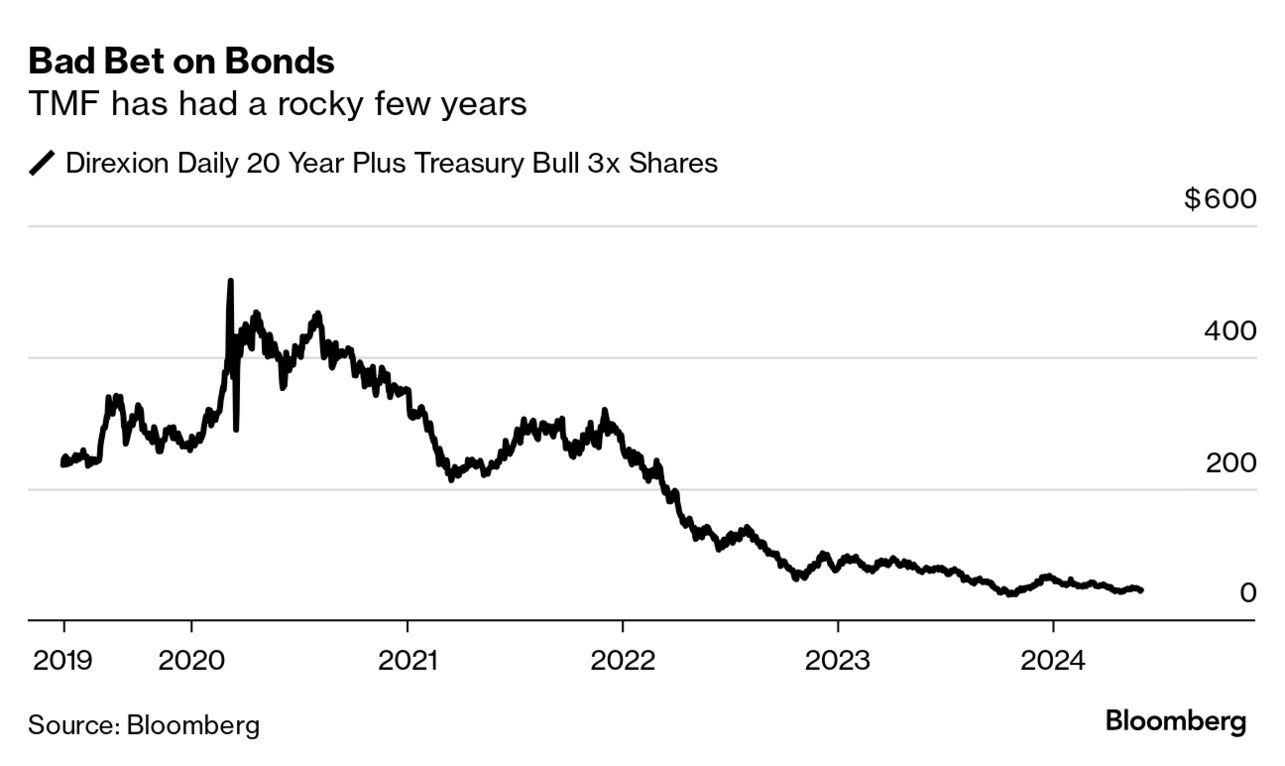
But perhaps the best example of this dynamic is the Direxion Daily 20-Year Treasury Bull 3X, which goes by TMF. Not for the faint of heart, TMF uses derivatives to deliver three times the performance of long-dated Treasuries.

As such, TMF is in the midst of a drawdown of epic proportions. The ETF is nursing losses of nearly 27% so far in 2024, building on last year's drop of roughly 13%. 

Despite the terrible showing, money continues to pour in. TMF attracted a record $4 billion in 2023 and has added another $1.3 billion so far this year. That's the biggest inflow among leveraged ETFs.

There's no satisfying reason why traders keep throwing cash at these money-losing leveraged funds. One of the most popular theories out there is that these products appeal to day traders who crave volatility and the possibility of big pay-days — TMF certainly checks both boxes.

In Other News

Investors pulled money from ETFs in China in May for the first time in 15 months, raising questions over the strength of a recent stock market rebound.

Cathie Wood's Ark Investment Management has purchased a stake in Elon Musk's artificial-intelligence startup xAI.

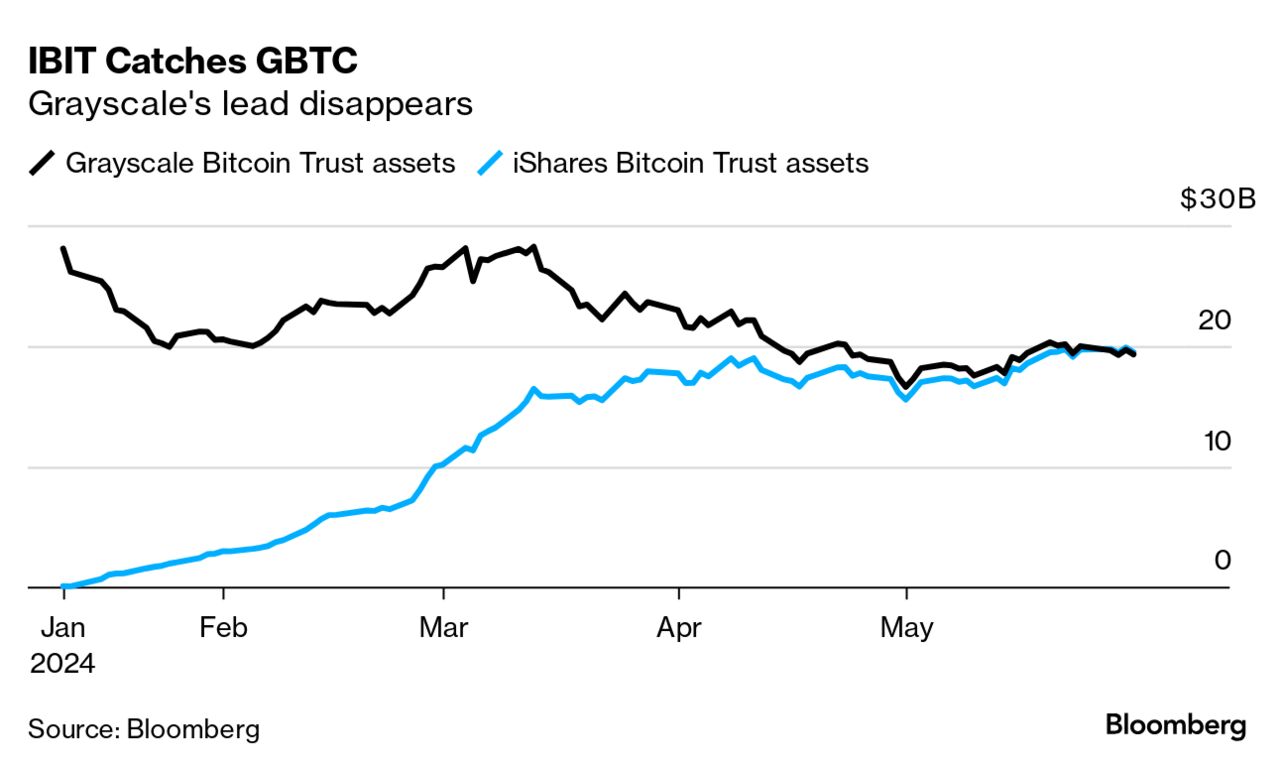
BlackRock Inc.'s IBIT has become the world's largest Bitcoin fund, amassing almost $20 billion in total assets since listing in the US at the start of the year.

Bloomberg

Drill Down

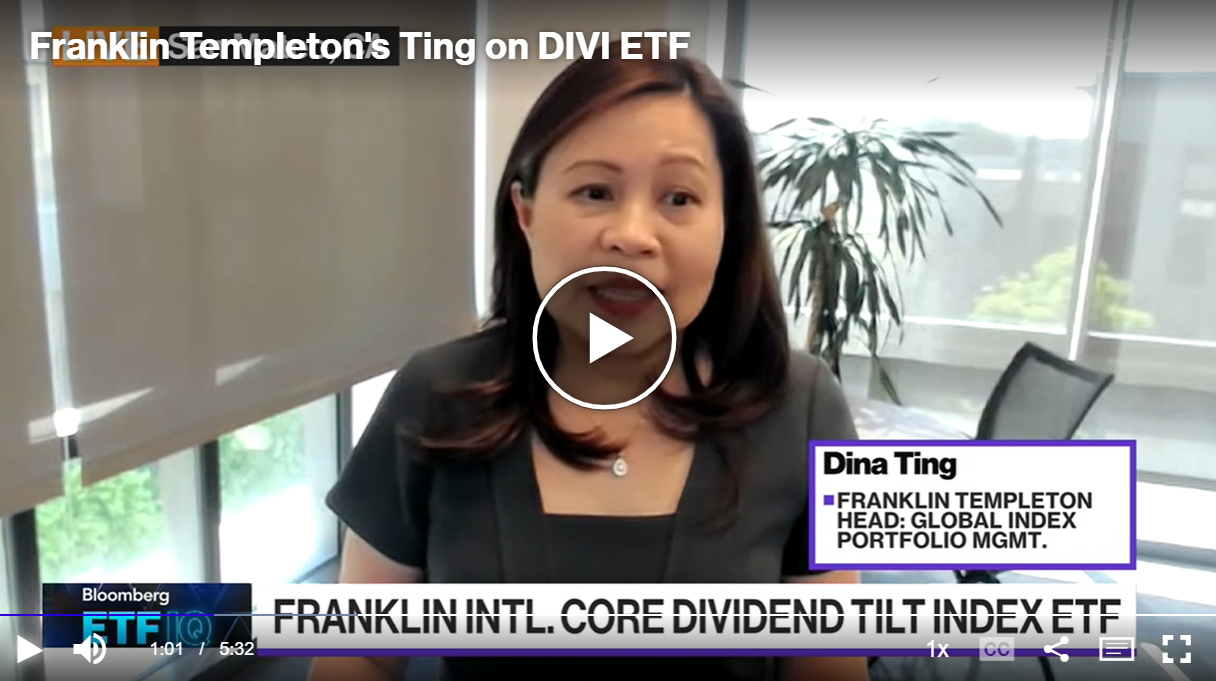
In this week's Drill Down on Bloomberg Television's ETF IQ, Franklin Templeton's head of global index portfolio management Dina Ting stopped by to talk about the Franklin International Core Dividend Tilt Index ETF (ticker DIVI). As the name suggests, DIVI invests in non-US equities that pay out dividends. 

A peek at the portfolio shows that DIVI's biggest geographic exposure is Japan at roughly 21%, followed by a nearly 14% weighting to the UK. Banks and pharmaceuticals rank as the fund's biggest sector exposures. In putting together the nearly 500 securities in the ETF, Ting said that outright dividend yields aren't the sole factor:

In this case, we want to balance the income and the capital appreciation, which means we believe that the sum of its parts is better than the individual... We're able to put in companies that have a higher capital appreciation even though they're not paying a high dividend, and combine that with a company who may have a lower expectation of return with the one that is paying a higher dividend.

DIVI charges 9 basis points and has amassed more than $830 million since its 2016 inception. So far, it's returned 5.6% in 2024.

Next Week on ETF IQ

VettaFi's Todd Rosenbluth and Sean O'Hara of Pacer ETFs join me, Eric Balchunas and Scarlet Fu on Bloomberg Television's ETF IQ. Watch live on Mondays at noon on Bloomberg Television, on the Bloomberg Terminal at TV <GO> and on YouTube.

No comments:

Post a Comment

Trump cannot stop this train

They know, as I do, this imminent event will trigger a once-in-a-generation wealth shift. Sponsored Content   They know, as I do, this immi...