Thursday, February 29, 2024

AI warfare is here

Plus: Big chocolate's new playbook

Welcome to Bw Daily, the Bloomberg Businessweek newsletter, where we'll bring you interesting voices, great reporting and the magazine's usual charm every weekday. Let us know what you think by emailing our editor here. If this has been forwarded to you, click here to sign up.

Must-Reads 

On a summer evening in 2020 at Fort Liberty, a sprawling US Army installation in North Carolina, soldiers from the 18th Airborne Corps pored over satellite images on the computers in their command post. They weren't the only ones looking. Moments earlier, an artificial intelligence program had scanned the pictures, with instructions to identify and suggest targets.

The headquarters of the 18th Airborne Corps at Fort Liberty.  Photographer: Cornell Watson for Bloomberg Businessweek

The program asked the human minders to confirm its selection: a decommissioned tank. After they decided the AI had it right, the system sent a message to an M142 Himars—or High Mobility Artillery Rocket System, the wheeled rocket launcher that's a mainstay of America's artillery forces—instructing it to fire. A rocket whistled through the air and found its mark, destroying the tank.

The explosion was unlike any other in the hundreds of live-fire exercises that occur each year on Fort Liberty's 146,000 acres of training grounds. In fact, it had no precedent in the Army. For the first time, American soldiers had struck a target located and identified by an AI program.

Less than four years after that milestone, America's use of AI in warfare is no longer theoretical. In the past several weeks, computer vision algorithms that form part of the US Department of Defense's flagship AI effort, Project Maven, have located rocket launchers in Yemen and surface vessels in the Red Sea, and helped narrow targets for strikes in Iraq and Syria, according to Schuyler Moore, the chief technology officer of US Central Command. The US isn't the only country making this leap: Israel's military has said it's using AI to make targeting recommendations in Gaza, and Ukraine is employing AI software in its effort to turn back Russia's invasion.

Navigating AI's transition from the laboratory into combat is one of the thorniest issues facing military leaders. Advocates for its rapid adoption are convinced that combat will soon take place at a speed faster than the human brain can follow. But technologists fret that the American military's networks and data aren't yet good enough to cope; frontline troops are reluctant to entrust their lives to software they aren't sure works; and ethicists worry about the dystopian prospect of leaving potentially fatal decisions to machines.

Meanwhile, some in Congress and hawkish think tanks are pushing the Pentagon to move faster, alarmed that the US could be falling behind China, which has a national strategy to become "the world's primary AI innovation center" by 2030.

A growing number of US military officers predict that AI will transform the way America and its enemies make war, ranking it alongside the radio and machine gun in its potential to revolutionize combat. In a signal of its possible ambitions, the US recently argued at the United Nations that human control of autonomous weapons is not required by international law.

Katrina Manson reports how AI is reshaping warfare at home and abroad.

The Chocolate Has Gone Missing 

Peanut-butter-filled M&M's. Reese's cups with added caramel. Hazelnut flavored Aero bars. Smaller Galaxy candy bars.

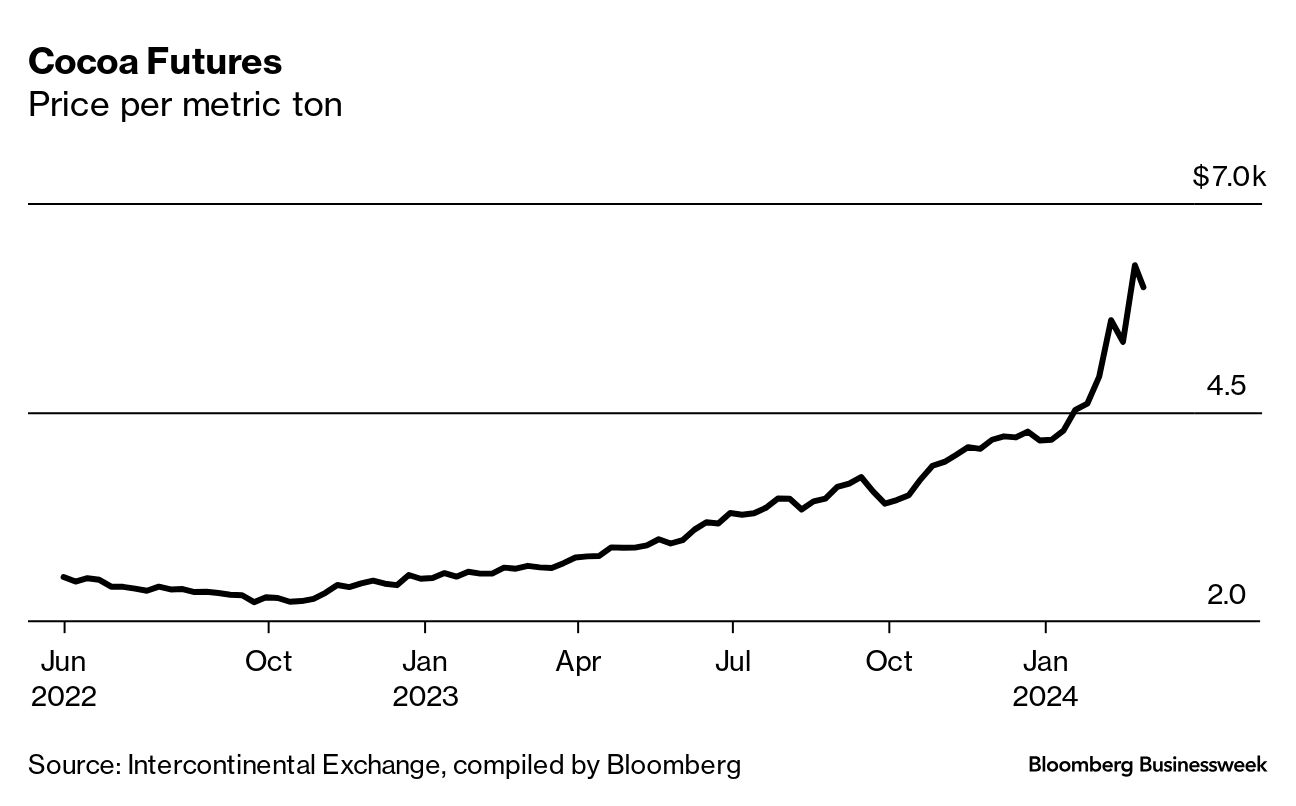
When the cost of cocoa rises, candymakers find ways to sell households smaller doses of chocolate—like the partially coated Chocolate Frosted Donut Kit Kats—or offer new goodies with no chocolate at all.

Cocoa prices have climbed to record highs and market participants don't expect any near-term relief. Cocoa futures traded in New York averaged well below $3,500 a metric ton every year from the 1980s until 2023. On Feb. 22 cocoa futures surpassed $6,000 a ton for the first time.

Ilena Peng writes that the market worries prices could still have further to run—leaving consumers shortchanged on chocolate.

Will the AI Era Supercharge Robotics Startups?

Robots have become increasingly powerful and common in recent years, but the most successful examples don't quite evoke the droids from Star Wars or Rosey from The Jetsons.

Illustration: Woshibai for Bloomberg Businessweek

IRobot Corp.'s Roomba vacuums and the Kiva robots that help run Amazon.com Inc. warehouses represent significant technical achievements, but they're more like automated appliances than AI-powered companions.

Attempts to satisfy the public's hunger for more personable robots have sometimes disappointed. (Remember Tesla's 2021 demonstration of a humanoid robot?) But people who work in the field say recent advances in AI models and computer vision software mean robots that physically resemble humans could soon be a reality. Humanoid robots that can carry out a wide range of tasks—in contrast to a robotic arm that deftly repeats a single function in a factory—could be particularly useful.

There's one big problem: The funding landscape remains brutal. Venture capital firms invested less in startups in 2023 than in any year since 2019, and humanoid robotics companies raised only a quarter of the capital they attracted in 2018. Priya Anand reports there are signs things could be changing.

Struggling Drivers

2.66%
That's the percentage of car loans 90 days or more delinquent in the fourth quarter of 2023, according to data from the New York Federal Reserve—above pre-pandemic levels and the 15-year average. Banks are worried about the risk of defaults amid high interest rates and elevated car prices.

Russia Raises the Stakes

"We remember the fate of those who sent their contingents to our country before and this time the consequences for the potential interventionists will be far more tragic."
Vladimir Putin
Russian president
Putin warned that NATO risks a nuclear conflict if it sends troops to aid Ukraine, ramping up pressure on Kyiv's US and European allies just as his own forces go on the offensive.

More From Bloomberg

  • CityLab Daily for top stories and ideas, curated for your inbox by CityLab editors
  • Green Daily for the latest in climate news, zero-emission tech and green finance
  • Screentime for a front-row seat to the collision of Hollywood and Silicon Valley
  • Tech Daily for what to know in tech
  • Prognosis for the latest in health, medicine and science — and what it means for you

Explore all Bloomberg newsletters at Bloomberg.com.

No comments:

Post a Comment

Learn what actually moves markets (not noise)

...