| Thanks for reading Hyperdrive, Bloomberg's newsletter on the future of the auto world. Read more about GM's business update here. By its chief executive's own admission, General Motors has had a bumpy year. New battery packs and dedicated electric-vehicle platforms were supposed to make 2023 the turning point when GM would sell EVs at high volumes. Instead, models based off its Ultium battery system have been slow out of the gate, and CEO Mary Barra has canceled or delayed investments. GM's robotaxi business, Cruise, had big ambitions to take its service to new cities and generate around-the-clock revenue in San Francisco. A series of safety incidents and its catastrophic handling of them with regulators forced the company to halt its fleet and its co-founder to resign. All the while, the United Auto Workers made unprecedented demands for their members in bargaining for a new labor contract. The union managed to secure significant pay raises and improved benefits after striking for six weeks. GM nevertheless has sent a $10 billion message: We'll be just fine. 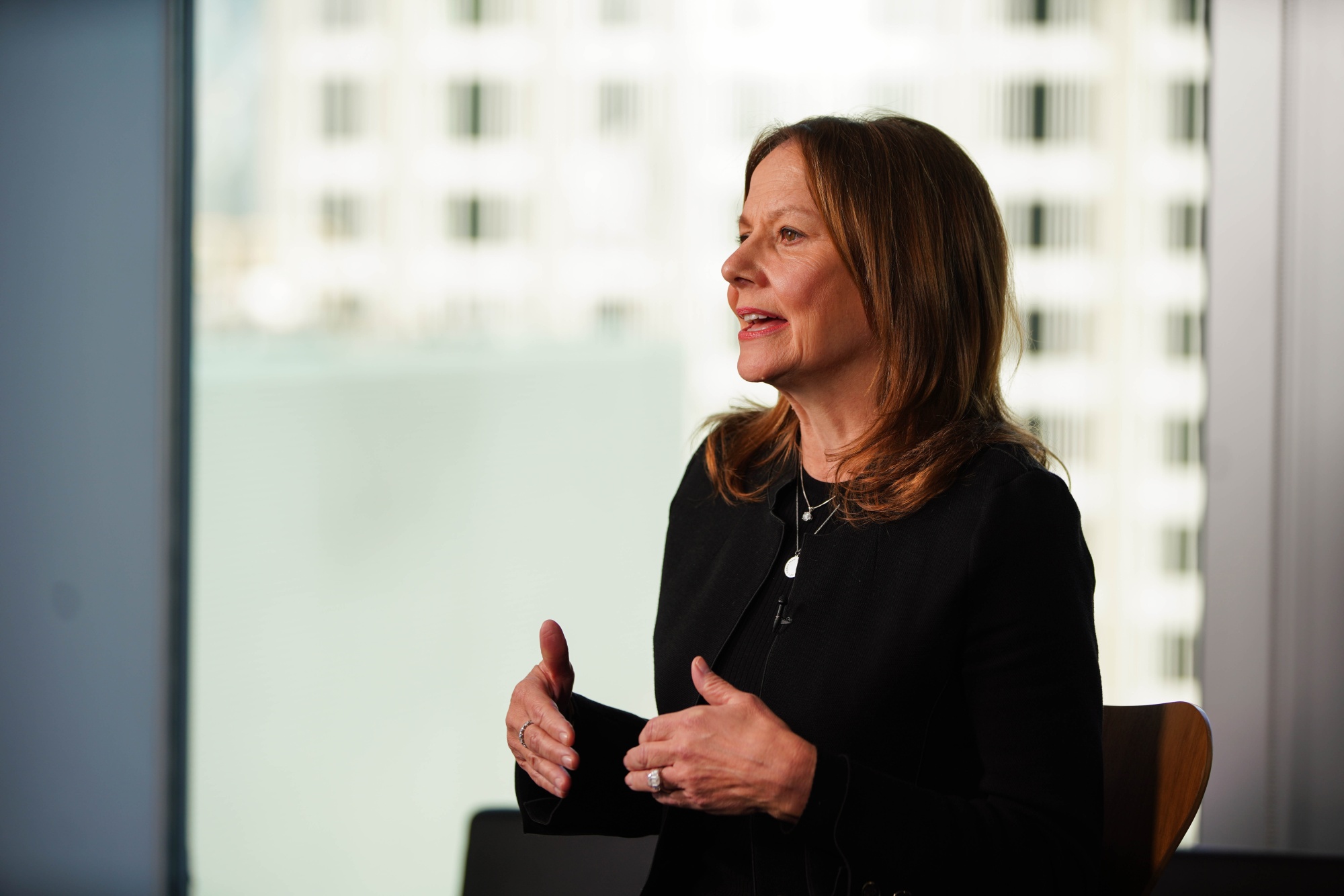 GM CEO Mary Barra during a Bloomberg Television interview Wednesday in New York. Photographer: Christopher Goodney/Bloomberg That's the amount of stock Barra vowed to buy back in what will be GM's biggest-ever repurchase program. The company also will increase the dividend it pays to shareholders by a third from next year. Making those two moves and reinstating its full-year earnings guidance sent GM shares soaring 9.4% on Wednesday, the stock's biggest gain in almost three years. Bloomberg Television's Jonathan Ferro spoke at length with Barra about GM's investor update. Here are highlights from the conversation that have been edited for length and clarity: Why have you decided to deliver a $10 billion buyback, shortly after you've signed a labor contract that adds $9.3 billion to expenses over its term? As we looked at the labor environment going into our negotiations, we had put conservative estimates into our plan. So although the cost was a little higher than what we expected, we'll be able to offset that. We did the right thing to recognize our manufacturing team members who have done a great job and continue to build vehicles safely with high quality, and we've also got to make sure that we're balanced across all of our stakeholders, and our owners are very important. Shareholders are super happy. I wonder if the UAW is? When you look at the suite of benefits that our represented team members have, it's a very appropriate package, and frankly leading from an industry perspective — broader than just the auto industry. We did the right thing to recognize and reward the hard work of our manufacturing team members, but also, one of the things they very much value is job security. To have job security, you have to have a strong company and you have to look at all of your stakeholders. We know you're looking to fully offset that labor contract — the additional cost from it. Have you identified where you will cut? A lot of this was already underway at the beginning of this year. We announced a $2 billion structural cost reduction between 2023 and the end of 2024. That's well underway. We also comprehended that we would have increases in our labor cost as we looked at what the environment was, and also wanting to reward our manufacturing employees. There's work going across many aspects of the business, including making our products more efficient. Are these additional costs forcing a change in execution, or a change in strategy? Definitely not a change in strategy. We're performing very well in the market, and we see that we're below the average incentives. That speaks to the strength of our internal combustion engine products. From an EV perspective, we have confidence in the portfolio we have. We're a bit disappointed this year that we were constrained by the automation to build modules, so this is not something that is fundamentally an issue with Ultium. It was more a manufacturing automation issue that we're working through, and we'll be out of it by the middle of next year and making improvement every quarter. We never thought that EV adoption would necessarily be a straight line. We've seen this in other markets; we're seeing it now in the US. When you look at the Chevrolet Equinox, as well as the Blazer and the Bolt that are coming, we're going to have products in that range of affordable vehicles that are going to be very important for EV adoption. Just how committed are you to Cruise? When you look at the progress that the Cruise team has made over the last eight years, it's substantial, and we've already demonstrated that the Cruise vehicle can perform at a level that's safer than a human driver. What we have learned with this incident is it's got to be significantly better than a human driver to drive adoption, and we have to do a much better job of working with the regulators. GM has a long reputation of working and being transparent with regulators at the local, state and federal level. As we do that and get the results of the independent review that we're doing, that will guide us on our path forward. What's behind the EV slowdown? There still is limited availability. When you look at the choice that customers have today, from an internal combustion engine vehicle perspective, a lot of the EVs that are out right now are more expensive. You've got to look at what the sweet spot of the market is. The growth hasn't gone in reverse; it's slowing. We thought it would have some bumps along the way, and that's what we're seeing right now. When we have EVs that are affordable, when people realize how much fun they are to drive, and the performance, and they're not giving anything up, and then that all-important charging infrastructure, we're going to see them start to grow at a more rapid rate again. GM's stock has been dead money for the better part of a decade. What's going to turn this around? When you look at a $10 billion accelerated buyback program, it means we have confidence in the cash-generation ability of this company. We have confidence in our strategy. Yes, we had some challenges this year with our Ultium-based EVs that gave investors some concern, but we're demonstrating the confidence that we have that we're executing this strategy, and we're going to see growth, strong cash flow and strong margins. That's what we're going to deliver. — By Craig Trudell 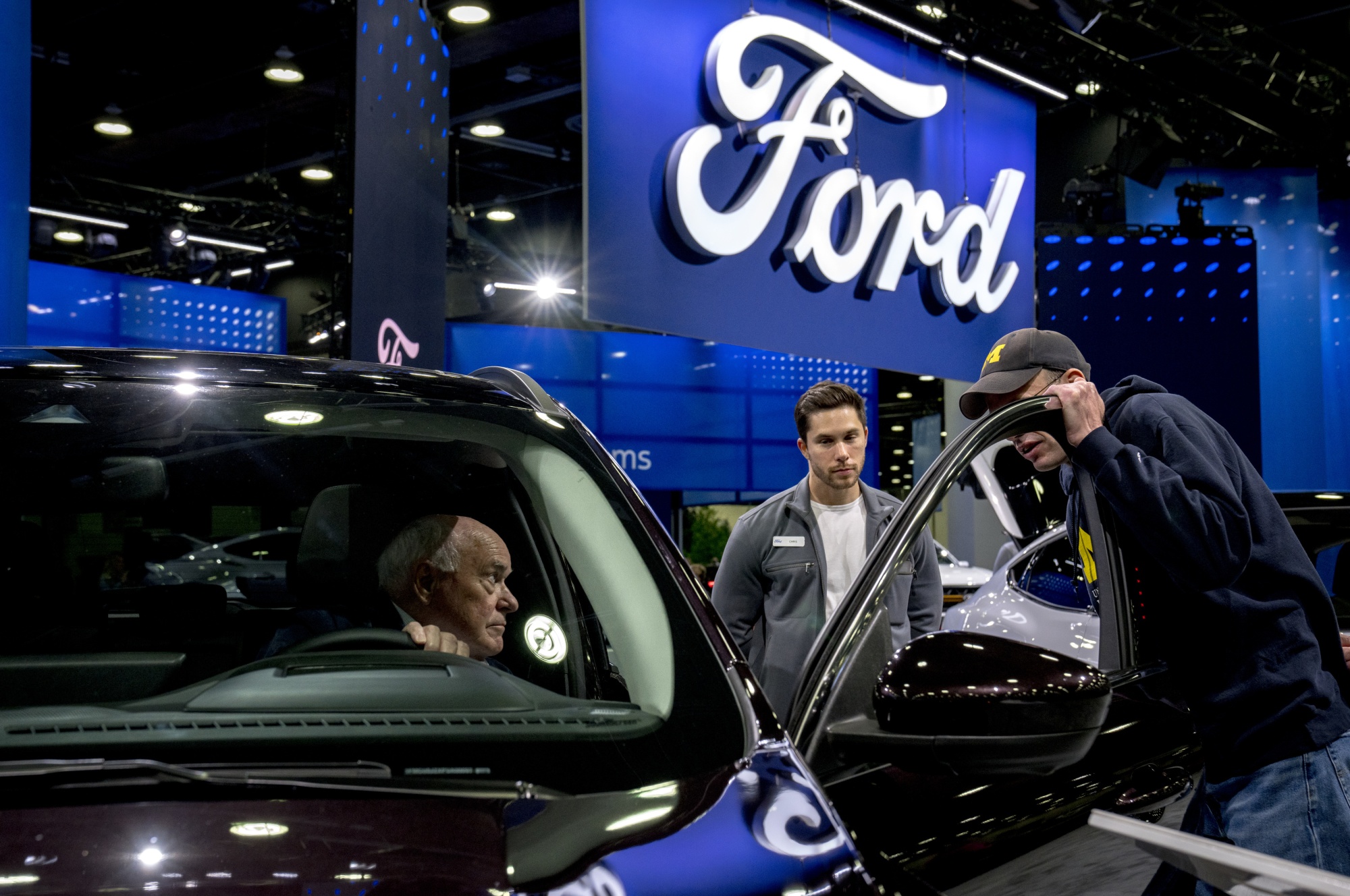 Attendees sizing up a Ford Escape during the 2023 North American International Auto Show in Detroit. Photographer: Nic Antaya/Bloomberg Ford warned Thursday that profits will come up short of earlier projections due to rising labor costs stemming from its new contract with the UAW. The carmaker now expects 2023 adjusted earnings before interest and taxes to be in the range of $10 billion to $10.5 billion, below the $11 billion to $12 billion that it forecast in July. Ford estimated its labor costs will rise by $8.8 billion over the duration of the contract with its 57,000 US hourly workers. The automaker previously said that higher labor costs would add about $900 to the cost of each car. 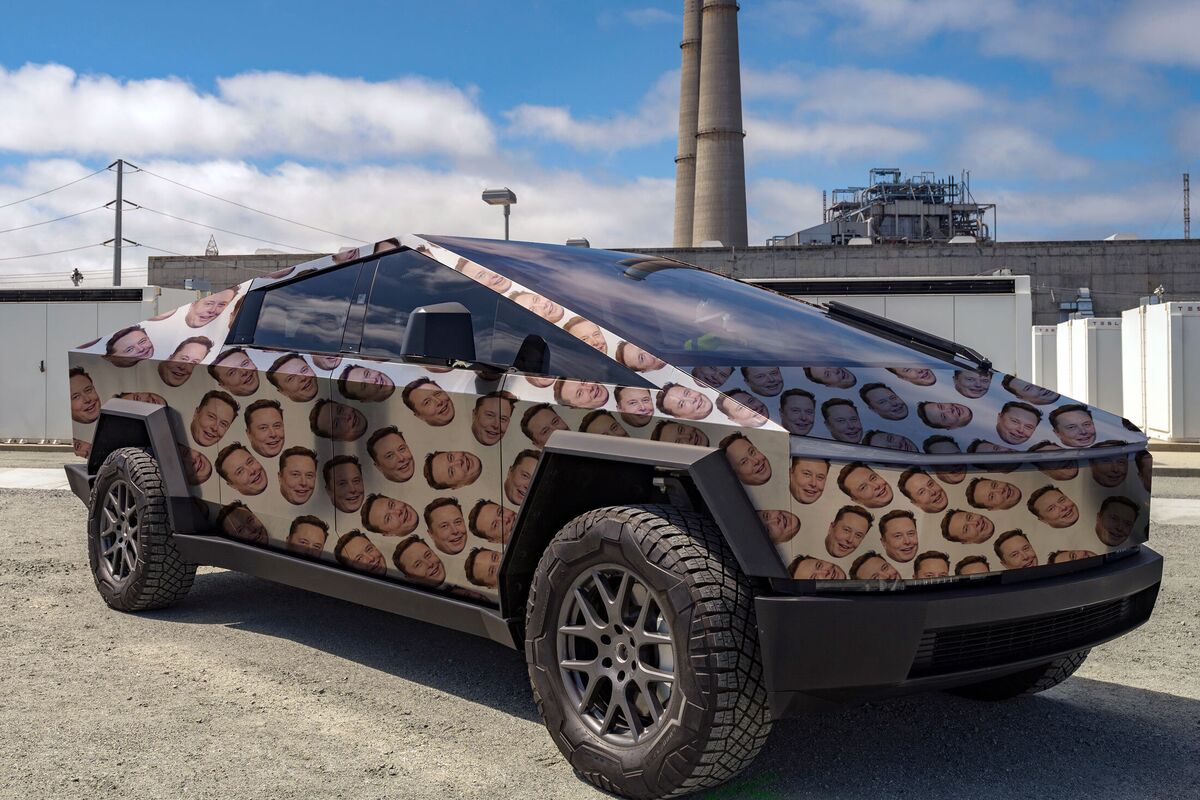 A hypothetical Cybertruck wrap, in bespoke Musk-leopard. Photo Illustration: 731; Bloomberg, Getty Images Tesla designed its stainless-steel Cybertuck to pull off what DeLorean tried and failed to in the early 1980s: market the first vehicle for the masses that doesn't require paint. When Tesla starts Cybertruck deliveries on Thursday, executives may discuss a strategy to use wraps as a workaround. A decorative film applied to the vehicle's exterior — and a lucrative upsell Tesla has been trying out in California — could soften the edges of a vehicle seen as too harsh for mainstream buyers. | 







No comments:
Post a Comment