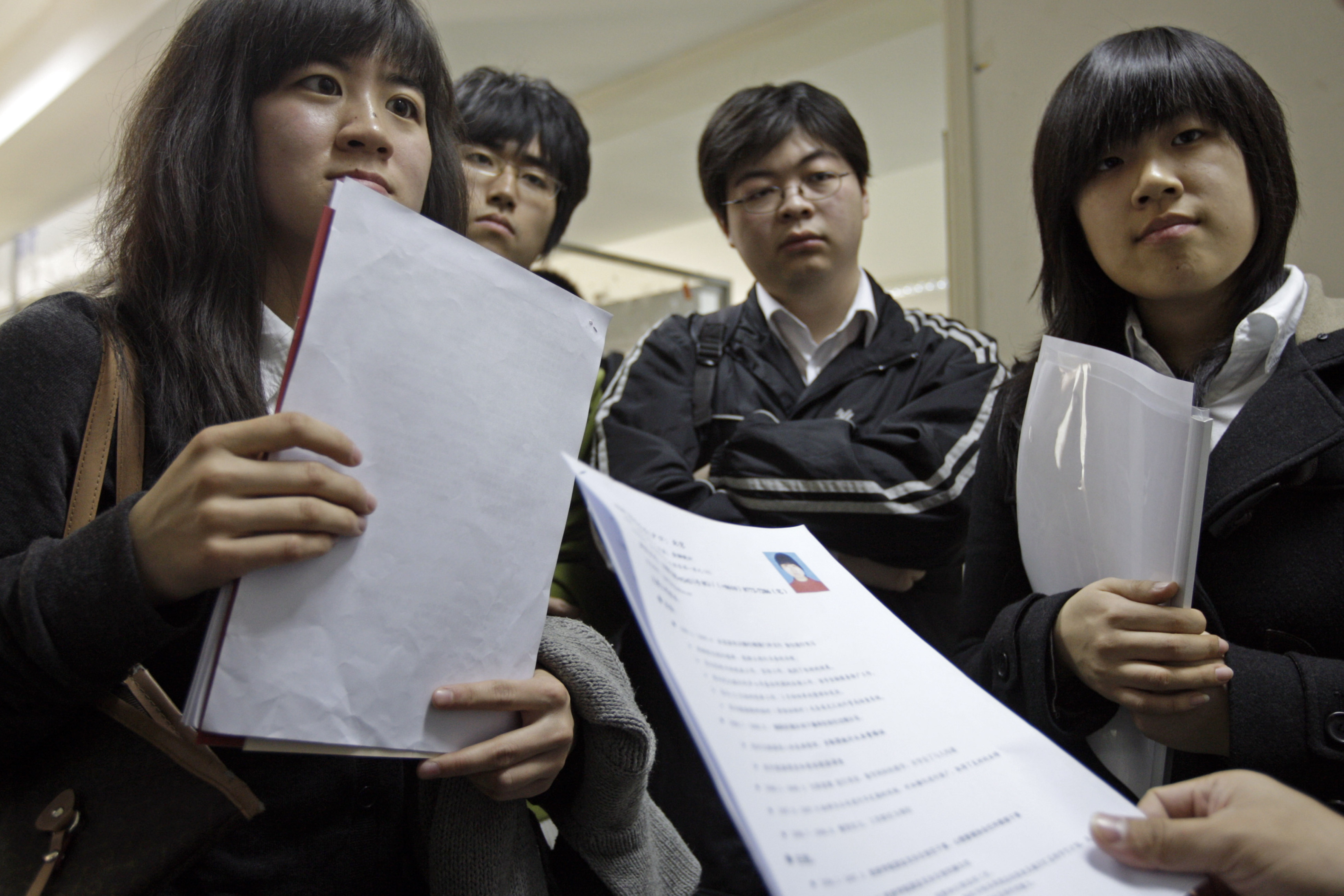
| As China's economy slows, what's been one of the country's most reliable investments is now looking less attractive. No, that isn't a reference to property or even shares in tech companies. Having a university degree in China has long been a sure-fire path to higher earnings. But that may be changing. Over the past two decades, Chinese graduates earned 10-20% more than their peers with similar attributes—age, gender, social background—but no college degree, economists estimate. With that kind of return, it's little surprise China's university enrollment rates have risen close to 60%—similar to developed countries. Indeed, about 12 million students will graduate from Chinese colleges this year—up from only about one million two decades ago. That's the fastest expansion of higher education ever seen in any country. But this happens to be a bad year to graduate in China. Why is 2022 so different than recent decades? China's no-compromise approach to the pandemic combined with a property slump have pushed youth unemployment close to 20%. That leaves an estimated 15 million Chinese between the ages of 16 and 24 out of work, Bloomberg reported this week. Ironically, Beijing accelerated higher-education expansion following the Asian financial crisis in the late 1990s as a way of reducing youth joblessness. Beijing subscribed to economic theories stressing the importance of "human capital" which gained prominence in the 1980s. In what became an annual tradition around graduation season, Chinese media—and sometimes foreign media as well—wrote alarming headlines about the record numbers of graduates hitting the job market, predicting widespread joblessness. But a crisis never occurred. Instead, "estimated premium-to-education increased hand in hand with the expansion in the higher education system in China," a 2015 study published in the Journal of the Asia Pacific Economy found, analyzing data through 2010. That reflected "demand for skilled labor outstripping the increase in supply as China moved into higher value-added production." While most studies put China's college wage premium around 10-20%, the effect was especially strong for students from China's relatively impoverished countryside. Those who made it through college earned 40% more than their peers with just primary education, according to a 2020 study. Overall the "great higher education expansion" has been a great investment—raising earnings by 17% for men and 12% for women, according to a study published this year in the China Economic Review, based on 2017 data. However, the authors wrote that "rural students have missed out on this historical opportunity," due to poor quality elementary and high school education in the Chinese countryside.  But now there's growing consensus that the return on education in China may be starting to decrease. A study published by the IZA Institute of Labor Economics last year charted a drop in the return rate from 2010 to a low of about 16% in 2015, though it rebounded back to 20% in 2017. The authors attributed that to the Chinese government's "supply-chain reform" and the "Made in China 2025" initiatives. But there's a more prosaic explanation: China's economy slowed after 2010 and deteriorated rapidly in 2015 due to a property market slump and stock market crash, before picking up by 2017 as Beijing used government spending to revive the housing sector. Since 2019, when China's economy entered another slowdown, anecdotal reports have suggested that graduates were having a harder time finding well-paid jobs, a situation worsened by the pandemic. There is hard data backing up the claim that graduate wages are falling. Expected starting salaries are down 6% this year from 2021, according to recruitment agency Zhilian. It's plausible that the graduate premium is falling again as it did in 2015. China's approach to higher-education may need a rethink, said Yuyang Kang, a researcher at Lingnan University in Hong Kong and author of a recent paper titled "The Broken Promise of Human Capital Theory." The research highlights the growing mismatch between labor market demands and college education. "The Chinese government must critically review the impact of higher education expansion," Kang argued. "There should be more effective articulation between higher education and changing labour market needs." One problem: Chinese universities are marked by a high student-faculty ratio, she noted. That means raising the return on college education may require more of a focus on education quality, rather than quantity. —Tom Hancock Get Bloomberg's Evening Briefing: Sign up here to receive our flagship newsletter in your mailbox daily, along with our Weekend Reading edition on Saturdays. | 







No comments:
Post a Comment